North India Statesman
[ad_1]
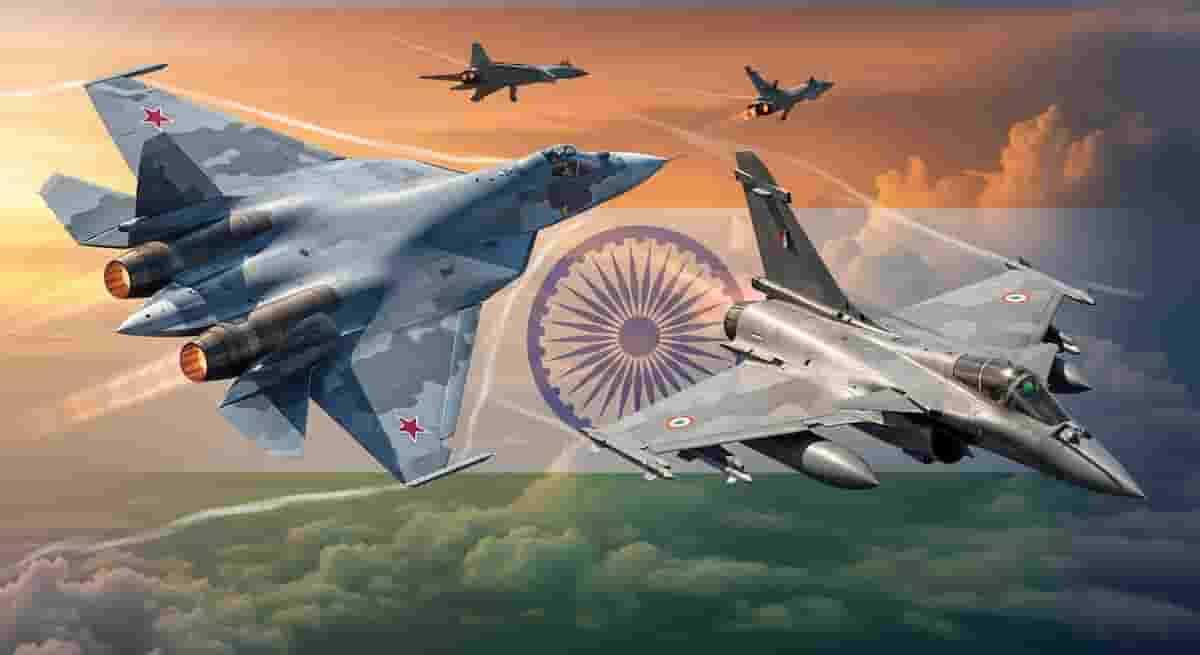
News India Live, Digital Desk: Indian Air Force: Today our Indian Air Force (IAF) is standing at an important turn where it has to prepare himself for future challenges. In place of fighter aircraft like our old mig-21 and Jaguar, there is a strong need for new and more powerful jets. We have only 31 squadrons against the 42 squadrons of our fixed need, which is a matter of concern for security. To meet this deficiency and especially to face the increasing dangers from China and Pakistan, India soon needs new and modern fighter aircraft. In the same ecstasy, two big fighter jets-Russia’s Sukhoi SU-57 and France’s Rafael F4-are presenting their own beauty for India’s security needs. This is not just a matter of buying some aircraft, but is a big decision of the future of our defense and self -reliance.
Let’s see, what are these two aircraft offering to India and what are their characteristics and challenges:
1. Sukhoi SU-57 of Russia: Fifth generation trust and golden opportunity to transfer technology
SU-57 is said to be a multi-rol fighter jet of Russia’s fifth generation stealth (not coming in the grip of radar). Russia has given India a very attractive offer for SU-57e (which is its export model). In this offer, not only selling aircraft, but also in Technology Transfer, in India itself, it has been promised to give access to its production (co-production) and even the entire ‘source code’. If India accepts this proposal, HAL (Hindustan Aeronautics Limited) will be able to manufacture SU-57 using facilities for SU-30MKI in Nashik. This will strengthen our dream of our ‘self-reliant India’, and will also provide the facility to install Indian weapons like BrahMos-e, Astra and Rudram missiles in it.
What are the special things of SU-57?
- Fifth generation power: It is said to be equipped with stealth design, internal weapons capacity, supermanuvability (too much maneuver capacity), open architecture (open architecture) and modern avionics. It can fly at the speed of Mach 2 (double at the speed of sound) with a range of 3500 km and carry 10 -ton -weight payload (weapon and other equipment).
- Low cost and powerful capacity: Its estimated cost is around $ 35–40 million per jet, making it quite economical with Rafael F4. It is capable of carrying nuclear weapons and can also work with drones in ‘Loyal Wingman’ mode. Its efficiency in the air fight is said to be magnificent.
- Deep friendship with Russia: India’s decades -old defense partnership with Russia has been reliable. Russia also gives us more discounts in weapons customization (change according to its need).
Troubles are also no less:
- Some experts believe that its ‘stealth capacity’ is not as advanced as it looks on papers, and its radar cross section (RCS) can be equal to or more (0.1–1 sq meter) of Rafael F4, while America’s F-35’s RCS is 0.001 square meters.
- Many experts still consider it a “4 ++” generation aircraft, as its engine (AL-41F1S) is not completely of the fifth generation level.
- India had earlier removed the FGFA (fifth generation fighter aircraft) project with Russia due to cost and performance concerns. The sanctions imposed by Western countries can also cause a delay in its delivery.
2. Rafael F4 of France: Siddha performance and expansion of trust
The Indian Air Force has sent a proposal to the Ministry of Defense to buy F4 variants of 114 new Rafale fighter jets from France. Rafael F4 is called a 4.5-generation multi-rall fighter jet, which has capabilities like fifth generation aircraft, but does not have full stealth capacity. The Indian Air Force is already using 36 Rafale Jet (F3R variants), so it will be comparatively easy to include F4 in the fleet, train soldiers and maintain it.
What are the special things of Rafael F4?
- Omni-Roll Capacity: Rafael is known for its ‘Omni-Rol’ ability, that is, it can do a variety of work together, including air to air, with air to land and detective missions.
- Advanced Arms System: It can be equipped with powerful weapons such as Meteor BVRAM (missile more than 150 km range), Mica missiles, AASM hammer bombs (up to 70 km) and scalp/store shadow cruise missiles (more than 250 km).
- Siddha performance: Rafael has proved his credibility and war capabilities in the stressful situation of East Ladakh with China in 2020 and the attacks on Pakistan during ‘Operation Sindoor’. It dodged the Chinese PL-15 missiles.
- Advance Technology: This includes spectra electronic warfare suits, RBE2 AESA radar, OSF IRST and AI-based networking systems, which help the pilot to take the right decision immediately.
- Saffran engine (safran m88): The Rafale uses the M88 engine of the French Saffron Company, which is compact and lighter, which increases the speed and agility of the jet. Saffron is also working with India to create a high-utst engine for the Indian AMCA project, which is a sign of a major cooperation in engine technology.
There are also problems:
- price: The proposed deal of 114 Rafael F4 Jet is more than Rs 2 lakh crore (about $ 24 billion), which can cost the estimated cost of an aircraft to be significantly higher (about $ 120-210 million per jet).
- Technology Transfer: Although more than 60% indigenous material has been promised under ‘Make in India’, the facility like complete access to source code is not yet clear as Russian offers.
India’s confusion and decisive decision:
The Indian Air Force has to look at immediate needs (changing old aircraft and completing squadron deficiency) on the one hand, on the other hand the future security strategy, in which indigenization and self -reliance (eg AMCA project) are prominent.
- Product vs. Technology: Russia’s SU-57 promises to give a 5th generation aircraft at a relatively low price with “deep” technology transfer and source code. This will help India a lot in developing its own 5th/6th generation aircraft. At the same time, Rafael F4 is a ‘Siddha Warrior’, with which the Indian Air Force has a good experience and its ‘Make in India’ proposal will redeem the existing infrastructure. However, as full technology transfer as SU-57 is not yet clear for Rafael.
- Cost: SU-57 is clearly cheaper than Rafael F4, which can be an important factor for such a large order.
- Reliability and political relationship: Both countries have been reliable partners of India. There are decades -old strong relationships with Russia, while France has emerged as an important defense partner in recent years.
Finally, this decision of India will not be limited to the capacity of fighter aircraft, but it will be a major and far-reaching step towards building our long-term strategic freedom, economic impact, geopolitical relations and our own advanced defense industrial capacity. India not only needs some very advanced ‘top-tier’ fighters, but also a large number of workheors aircraft with ‘middle-tier’. Therefore, perhaps it is not just a question of choosing “a” aircraft, but also to balance between the two or adopt a mixed model, which can fulfill our safety needs and dreams of self-reliance simultaneously.