North India Statesman
[ad_1]
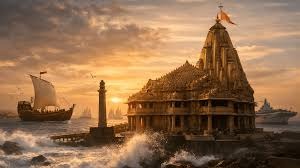
News India Live, Digital Desk: Whenever there is talk of India’s glorious history and spirituality, the name of Somnath Temple will come at the top. This is a place which the Mughal invaders tried to destroy many times, but it emerged with greater grandeur every time. Let us look at those aspects of this holy place that make it special.
1. Why is it called the ‘first’ Jyotirlinga?
It has its roots in mythology. It is said that this Jyotirlinga of Lord Shiva was established by the Moon (Soma) himself. When the moon started losing its brightness due to the curse of Prajapati Daksh, he performed severe penance for Mahadev on this very bank. Shiva appeared and freed him from the curse and gave him the boon to reside here. Because here the Moon regained its glory, hence it was called ‘Som-nath’ i.e. Lord of the Moon and the first Jyotirlinga.
2. Arrow Pillar: Did ancient India also have a ‘map’?
There is an ‘arrow pillar’ in the temple complex, which is no less than a miracle. There is an arrow on this pillar which points towards the sea. It is written on it that there is no land or mountain directly from here to the South Pole. Imagine, in the era when there were no satellites and Google maps, how did our ancestors know that from here to Antarctica there was only sea?
3. Never ending existence
History is witness to the fact that Somnath temple was looted and destroyed 17 times. From Mahmud Ghaznavi to Aurangzeb, many invaders tried to destroy it. But it is said that truth never loses. After independence, the determination of the iron man Sardar Vallabhbhai Patel gave this temple its present grand form. This temple is a symbol of the ‘stubbornness not to accept defeat’ of Indians.
4. Amazing mathematics of construction style
The temple has been built on the seashore in such a way that despite salt water and strong winds, its strength remains intact even today. Its peak and sanctum sanctorum produce such sound waves (vibrations), which fill the devotees coming here with a different peace and positive energy.
5. Journey of gold, silver and stone
According to mythological beliefs, first of all Moon had made it of gold, then Ravana had made it of silver, Shri Krishna had carved it of sandalwood and King Bhimdev had carved it of stones. This shows that for centuries, kings and devotees have understood the importance of this temple.