North India Statesman
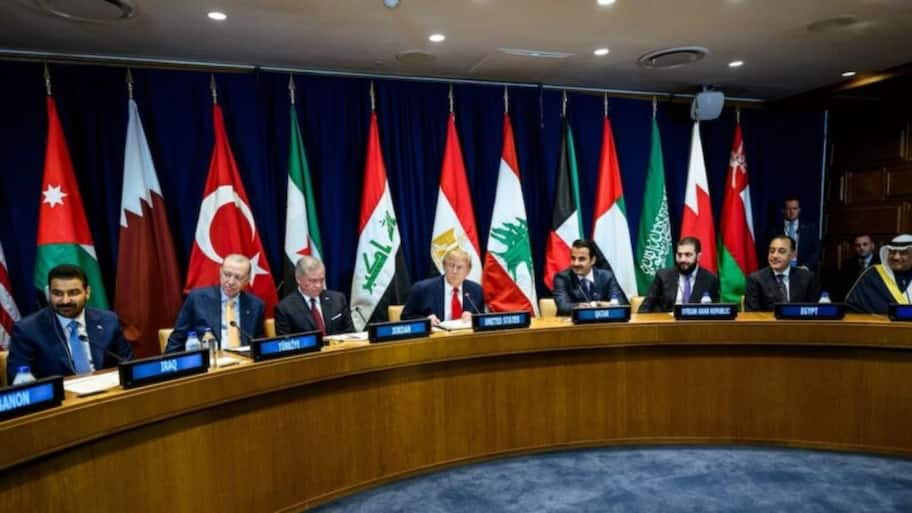
Amid ongoing military tensions in the Persian Gulf and chronic vulnerabilities surrounding critical maritime chokepoints, US President Donald Trump has thrown decisive weight behind the ambitious India-Middle East-Europe Economic Corridor (IMEC). Speaking against the backdrop of diplomatic maneuvers at the United Nations and escalating standoff scenarios with Tehran, the US administration framed the multi-modal transit network not merely as an infrastructure corridor, but as an essential geopolitical and energy bypass designed to guarantee the uninterrupted flow of Gulf energy supplies to global markets while sidelining Iranian leverage over international trade.
Neutralizing the Strait of Hormuz Chokepoint
A central strategic objective driving Washington’s renewed push for IMEC is reducing global reliance on the narrow Strait of Hormuz. With roughly a fifth of the world’s petroleum consumption transiting through the waterway daily, periodic threats of naval blockades, drone skirmishes, and tanker interdictions by Iran have repeatedly sent shockwaves through international financial and commodity markets. By linking deep-water ports across India’s western coastline directly to the United Arab Emirates and Saudi Arabia via rail and sea, and routing onward through Jordan and Israel to European ports like Piraeus and Marseille, IMEC provides a resilient land-sea conduit that avoids congested, high-risk waters.
Strategic Architecture: Rail, Pipelines, and Clean Energy Grids
First unveiled on the sidelines of the New Delhi G20 Summit, the IMEC architecture comprises two distinct wings—the East Corridor connecting India to the Arabian Gulf, and the Northern Corridor linking the Gulf to Europe. While initially envisioned as an expansive freight railway and digital data highway, planners and energy strategists have increasingly prioritized dedicated energy infrastructure along the right-of-way. The planned network incorporates hydrogen delivery pipelines, high-voltage electricity grids for clean energy export, and strategic petroleum connectivity designed to insulate European and South Asian economies from supply shocks.
Economic and Diplomatic Realignment Across the Middle East
The US administration’s backing of IMEC reflects a broader strategy to accelerate regional economic integration between key Arab nations and Israel. By cementing long-term commercial dependencies between Gulf states, Israel, and India, the corridor creates strong incentives for collective security and counter-terrorism coordination. For Washington, accelerating the route serves a dual diplomatic purpose: it builds upon the foundational architecture of the Abraham Accords and provides a credible, Western-partnered alternative to China’s multi-trillion-dollar Belt and Road Initiative (BRI) across the Eurasian landmass.
India’s Pivot as a Global Supply Chain Hub
For India, strong US backing for IMEC cements New Delhi’s growing stature as an indispensable anchor of global supply chains. Indian shipping hubs—including Jawaharlal Nehru Port Trust (JNPT), Kandla, and Mundra—are slated to experience expanded cargo volumes and lower logistics overheads, reducing transit times to Europe by an estimated 40 percent. Furthermore, the corridor strengthens India’s strategic partnership with Gulf allies, securing steady energy access and opening new export markets for Indian engineering, manufacturing, and agricultural products across the Mediterranean.
Implementation Hurdles and Regional Geopolitics
Despite the clear strategic impetus, turning IMEC into a fully operational reality faces formidable logistical and geopolitical hurdles. Missing rail links across the Arabian desert require billions of dollars in unified capital investment, standardized customs and rail gauges, and seamless cross-border regulatory harmonization. Moreover, persistent friction across the Levant and the fragile security dynamics surrounding Gaza and southern Lebanon continue to pose operational challenges for transit infrastructure running through Mediterranean ports. Nonetheless, Washington’s explicit endorsement of IMEC underscores a structural shift in global trade planning: moving away from vulnerable maritime flashpoints toward fortified, land-backed multimodal economic corridors.