North India Statesman
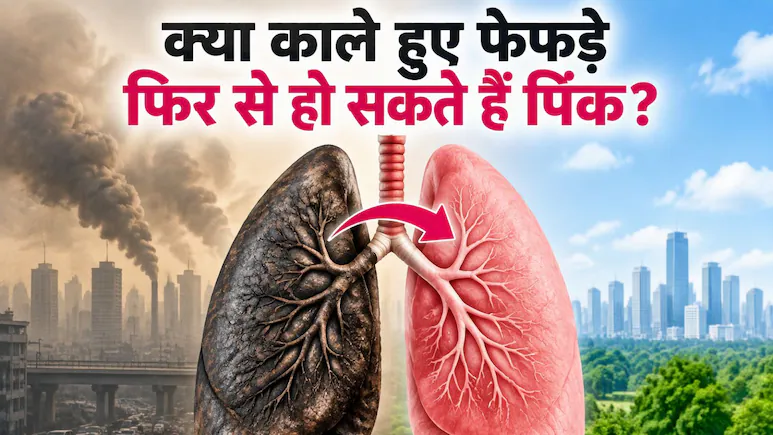
As winter settles across Northern India, millions of residents in industrial corridors and metropolitan regions like Delhi-NCR, Lucknow, and Kanpur face a hazardous air quality index (AQI) spiked with fine particulate matter ($PM_{2.5}$ and $PM_{10}$), heavy metals, and industrial exhaust. Medical scans of long-term urban dwellers often show microscopic carbon deposits, giving rise to deep health worries: Can lungs blackened and damaged by toxic air pollution ever return to health, or is the physical injury permanent?
Pulmonologists and respiratory experts confirm that human lungs possess remarkable self-cleaning mechanisms and cellular repair capabilities. However, whether your respiratory system can fully recover depends on the duration of exposure, your baseline lung function, and the structural nature of the underlying tissue damage.
How Air Pollution Blackens Human Lungs: The Biological Process
When you breathe polluted ambient air, microscopic carbon particles, soot, and industrial combustion residue bypass the physical filtering hair inside your nasal passages. These fine toxic particles ($PM_{2.5}$ and smaller) travel deep into the bronchial tree, reaching the microscopic air sacs known as alveoli where oxygen exchanges directly into the bloodstream.
Specialized immune cells called alveolar macrophages act as your body’s frontline defenders. They engulf these inhaled carbon particles to protect surrounding tissue. However, human digestive enzymes cannot break down elemental carbon and heavy metals. As macrophages consume particle after particle, they become overloaded, die, and deposit their dark soot contents permanently into the lung tissue lining (the interstitium) and local lymph nodes. Over years of toxic exposure, this process creates visible dark mottling known clinically as anthracosis—the characteristic “blackened” appearance seen in urban residents and heavy smokers alike.
The Natural Self-Cleaning Mechanisms of the Human Respiratory System
Despite continuous exposure to ambient toxins, your lungs are not passive filters; they operate a sophisticated self-cleansing system designed to clear microscopic debris.
The Mucociliary Escalator: The inner lining of your airways is coated with a thin layer of protective mucus and lined with millions of microscopic, hair-like structures called cilia. Operating in a synchronized wave-like motion, cilia constantly push mucus and trapped dust upward away from the lower lungs toward the throat, where it is swallowed harmlessly or coughed out as phlegm.
-
Airway Clearance: Once high-AQI exposure drops, the mucociliary escalator speeds up debris removal, gradually clearing trapped surface particles over weeks and months.
-
Cellular Regeneration: Epithelial cells lining the upper respiratory tract regenerate every few weeks, replacing damaged cells with fresh, healthy tissue once clean air replaces smog.
-
Macrophage Clearance via Lymphatics: Over extended periods in clean environments, lymphatic vessels slowly carry away trapped interstitial pigment, lightening tissue staining over time.
Reversible Damage vs. Permanent Fibrosis: Where Doctors Draw the Line
Medical specialists emphasize a vital distinction between acute airway inflammation and permanent structural scarring:
| Health Parameter | Reversible Inflammation | Permanent Structural Fibrosis |
| Primary Cause | Short-term severe AQI spikes, seasonal smog, acute bronchitis | Decades of heavy pollution, chronic smoking, untreated severe COPD |
| Tissue Affected | Bronchial mucosal lining and airway smooth muscle cells | Alveolar walls, elastic fibers, and deep interstitial tissue |
| Symptoms | Cough, wheezing, throat irritation, temporary breathlessness | Persistent breathlessness, reduced lung capacity, oxygen dependence |
| Recovery Outcome | Full to partial recovery once air quality improves and treatment starts | Irreversible scarring; management focuses on preventing further loss |
While acute airway hyper-reactivity, swelling, and mucus hyper-secretion clear up once clean air returns, long-term exposure can cause permanent fibrotic scarring. Once delicate alveolar walls break down or turn into fibrous scar tissue, those specific units cannot regenerate. The goal of medical intervention shifts toward protecting the remaining healthy tissue.
Medical Strategies and Lifestyle Actions to Accelerate Lung Healing
If you have spent years living in high-pollution zones, proactive steps can significantly boost your natural lung recovery and lower your risk of chronic respiratory illness:
-
Eliminate Secondary Irritants: Avoid tobacco smoke, indoor incense, mosquito coils, and unventilated cooking fumes. Adding indoor pollutants to external smog severely compromises cilia movement.
-
Practice Deep Breathing & Pulmonary Rehabilitation: Controlled diaphragmatic breathing, Pranayama (like Anulom Vilom in clean indoor air), and light aerobic exercises strengthen diaphragm muscles and optimize lung expansion.
-
Use HEPA Air Filtration: Using high-efficiency particulate air (HEPA) purifiers indoors reduces your $PM_{2.5}$ intake by over 80%, giving your respiratory system a safe recovery environment during sleep.
-
Stay Hydrated and Eat Antioxidant-Rich Foods: Adequate water intake thins airway mucus, allowing cilia to move freely. Diets rich in Vitamin C, Vitamin E, omega-3 fatty acids, and green leafy vegetables combat systemic oxidative stress caused by heavy metals.
-
Get Timely Medical Evaluations: If you experience a persistent cough lasting over three weeks, wheezing, or shortness of breath during daily routines, consult a pulmonologist for Spirometry (Pulmonary Function Test) to assess your actual lung volume and catch early-stage airway obstruction.