North India Statesman
Chhath Puja 2026 will be observed across four days from Friday, November 13, to Monday, November 16, 2026, with the main evening offering, Sandhya Arghya, falling on Sunday, November 15. Rooted in ancient Vedic traditions, this major Hindu festival is dedicated to Surya Dev, the Solar Deity, and Chhathi Maiya, revered as the divine protector of children and family well-being. Observed annually on the sixth day of the bright lunar fortnight in the Hindu month of Kartik, known as Kartik Shukla Shashthi, the festival arrives six days after Diwali. Millions of devotees across Bihar, Jharkhand, eastern Uttar Pradesh, West Bengal, Delhi-NCR, and the global Indian diaspora are preparing for one of the most rigorous yet deeply spiritual observances in the Hindu calendar. Unlike most festivals that revolve around temple rituals or idol worship, Chhath is celebrated outdoors in direct communion with nature, requiring extreme physical discipline, absolute cleanliness, and a gruelling 36-hour waterless fast. According to Drik Panchang calculations, the auspicious Shashthi Tithi commences at 11:23 PM on November 14 and concludes at 2:00 AM on November 16, establishing the exact astronomical window for the primary ghat rituals.
Day 1: Nahay-Khay Rituals and Timings on November 13
The four-day spiritual journey commences on Friday, November 13, 2026, with Nahay-Khay, which literally translates to “bathe and eat”. On this opening day, sunrise occurs at approximately 6:42 AM in New Delhi and around 6:06 AM in Patna. Vratis, the devotees observing the fast, begin their morning by taking a holy dip in sacred rivers such as the Ganga, Yamuna, or Kosi, or in clean local ponds and household water bodies. Following the ritual bath, households undergo deep purification, and devotees prepare a strictly sattvic meal cooked without onion, garlic, or common table salt, using only rock salt (sendha namak). The traditional meal consists of boiled arwa rice, chana dal, and bottle gourd curry (kaddu bhat), prepared on clean stoves to detoxify the body and mind before the demanding fast ahead.
Day 2: Lohanda and Kharna Schedule on November 14
The second day, known as Lohanda and Kharna, falls on Saturday, November 14, 2026. On this day, devotees observe a strict day-long fast without consuming even a single drop of water from sunrise until sunset. Once the sun sets—around 5:28 PM in New Delhi and 5:01 PM in Patna—devotees perform evening prayers to Surya Dev and Chhathi Maiya. They then prepare the sacred Kharna prasad over an earthen stove fuelled by mango wood, cooking jaggery-based rice pudding (rasiyaav or gur ki kheer) alongside plain wheat rotis. After offering the food to the deities, the Vrati consumes the prasad in complete silence, sharing the remaining portion with family and neighbours. The moment this evening meal concludes, the unbroken 36-hour nirjala (waterless) fast officially begins, testing the devotee’s physical endurance and spiritual resolve.
Day 3: Sandhya Arghya Sunset Offerings on November 15
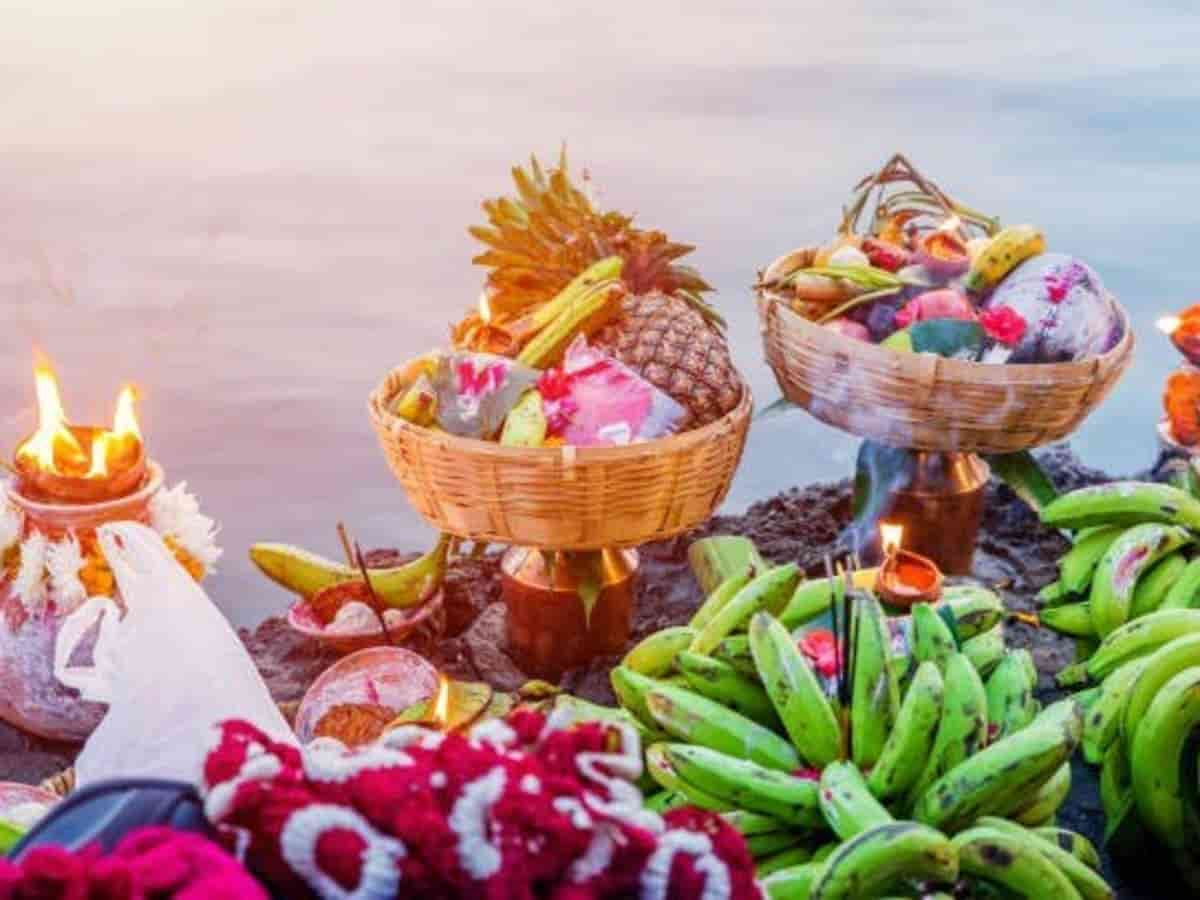
Sunday, November 15, 2026, marks the pinnacle of the festival with Sandhya Arghya, the evening offering to the setting sun. In the afternoon, families dress in traditional attire and walk barefoot in celebratory processions toward decorated riverbanks, lakes, and community ghats, carrying woven bamboo baskets (daura) and winnowing trays (soop) filled with offerings. These baskets hold freshly prepared thekua (a crispy wheat-and-jaggery sweet), rice laddoos (kasar), sugarcane stalks with leaves, sweet limes, bananas, water chestnuts, coconuts, and raw turmeric and ginger plants. Standing waist-deep in the cool water as traditional Bhojpuri and Maithili folk songs echo across the banks, devotees offer raw milk and water to the descending sun. Because sunset times vary geographically across India’s single time zone, devotees in eastern cities perform the ritual much earlier than those in the west. In Kolkata, sunset is at 4:53 PM, followed by Patna at 5:01 PM, Ranchi at 5:04 PM, Varanasi at 5:10 PM, Lucknow at 5:16 PM, New Delhi at 5:28 PM, and Mumbai at 6:00 PM.
Day 4: Usha Arghya and Parana Timings on November 16
The festival culminates on Monday, November 16, 2026, with Usha Arghya, the dawn offering to the rising sun, followed by Parana. Long before daybreak, devotees return to the ghats in the pre-dawn chill, lighting rows of earthen diyas along the water’s edge while waiting for the first rays of sunlight. Standing once again in the water, they offer milk and water to the rising sun, praying for the health, prosperity, and longevity of their families. City-wise sunrise timings for Usha Arghya on November 16 are 5:50 AM in Kolkata, 6:03 AM in Ranchi, 6:07 AM in Patna, 6:16 AM in Varanasi, 6:26 AM in Lucknow, 6:44 AM in New Delhi, and 6:46 AM in Mumbai. Immediately after completing the morning arghya and seeking blessings from elders, devotees perform Parana—breaking their 36-hour fast by consuming a small piece of ginger, jaggery, and water, before distributing the sacred thekua and fruit prasad to everyone present.
City-Wise Chhath Puja 2026 Arghya Timings and Civic Preparations
Because India operates on Indian Standard Time (IST) across vast longitudinal distances, verifying exact local sunrise and sunset schedules is essential for timely offerings. The table below outlines the official Sandhya Arghya and Usha Arghya timings across major Indian cities for 2026:
| City / Region | Sandhya Arghya (Nov 15 Sunset) | Usha Arghya (Nov 16 Sunrise) |
| Patna (Bihar) | 5:01 PM | 6:07 AM |
| Ranchi (Jharkhand) | 5:04 PM | 6:03 AM |
| Varanasi (Uttar Pradesh) | 5:10 PM | 6:16 AM |
| Lucknow (Uttar Pradesh) | 5:16 PM | 6:26 AM |
| New Delhi (Delhi-NCR) | 5:28 PM | 6:44 AM |
| Kolkata (West Bengal) | 4:53 PM | 5:50 AM |
| Mumbai (Maharashtra) | 6:00 PM | 6:46 AM |
State administrations in Bihar, Jharkhand, Uttar Pradesh, and Delhi have rolled out extensive civic arrangements ahead of tomorrow’s start, deploying NDRF safety teams, installing barricades at deep-water ghats, and setting up temporary artificial ponds for urban neighbourhoods. In Bihar and Jharkhand, November 16 has been notified as a public and bank holiday, while district authorities across Uttar Pradesh and Delhi have announced local traffic advisories to ensure smooth passage for families heading to the riverbanks. Devotees are advised to reach their designated ghats at least 30 to 45 minutes prior to the scheduled sunset and sunrise windows and dress warmly for the crisp November mornings.