North India Statesman
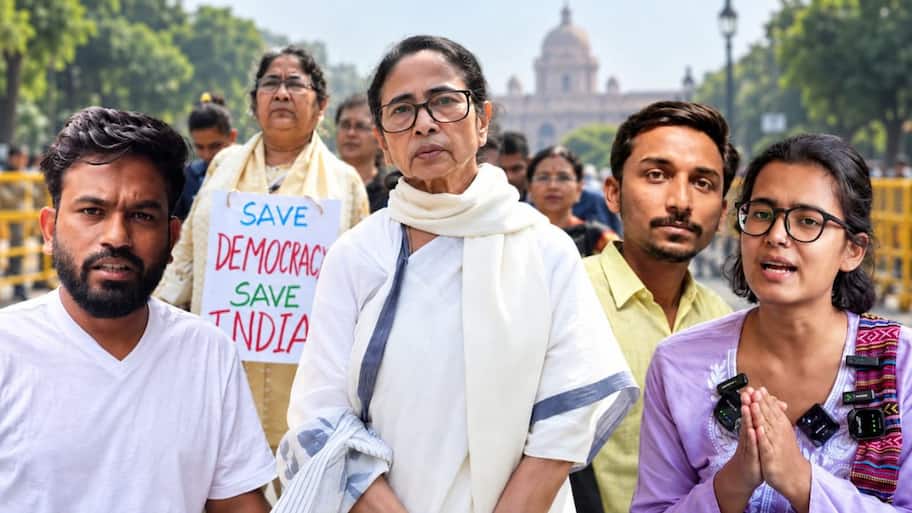
The political confrontation surrounding the Election Commission’s controversial Special Intensive Revision (SIR) reached a boiling point on Saturday, October 10, 2026, as Delhi Police initiated sweeping preemptive detentions across the national capital. High-profile political figures—including Trinamool Congress (TMC) supremo Mamata Banerjee, Aam Aadmi Party leaders, and All India Students’ Association (AISA) president Neha Bora—were bundled into police vehicles as they attempted to join or mobilize demonstrations organized by the Cockroach Janta Party (CJP). Banerjee, accompanied by key party colleagues including Derek O’Brien and Dola Sen, was detained while staging a protest dharna near South Avenue before their march toward Jantar Mantar could proceed. Calling the police action a suppression of fundamental rights, opposition voices accused the administration of turning central Delhi into a fortress to insulate the poll panel from public accountability.
What Sparked the Confrontation: The EC-SIR Voter Revision Dispute
At the epicenter of the escalating agitation is Chief Election Commissioner (CEC) Gyanesh Kumar and the Election Commission’s rollout of the Special Intensive Revision (SIR). Protesting student bodies, regional parties, and youth activists allege that arbitrary procedural shifts under the SIR and revisions to Form 6 verification norms have led to large-scale, asymmetric disenfranchisement of legitimate voters, predominantly targeting youth, migrant laborers, and marginalized demographics. The CJP and supporting opposition outfits have made the immediate resignation of CEC Gyanesh Kumar their central, non-negotiable demand, insisting that transparent electoral audits be conducted before upcoming electoral exercises.
Ajinkya Shinde Steps to the Helm Under CJP’s ‘Plan B’
Despite the preemptive detention of CJP founder Abhijeet Dipke, spokesperson Saurav Das, and co-convenor Ashutosh Ranka upon their arrival at Indira Gandhi International (IGI) Airport, the demonstration did not collapse. Activating their pre-arranged operational succession protocol via a widely shared video, the party handed complete organizational control to National Organisation In-Charge Ajinkya Shinde. An engineer-turned-political-strategist with extensive youth mobilization experience, Shinde quickly issued decentralized directives urging student groups, civil society workers, and regional volunteers to bypass major barricades and assemble in coordinated pockets across central transit corridors.
Capital Under Lockdown: Metro Closures, Prohibitory Orders, and Street Friction
With thousands of agitators converging on central Delhi, the Delhi Police imposed Section 163 of the Bharatiya Nagarik Suraksha Sanhita (BNSS), strictly barring assemblies around key administrative buildings and Jantar Mantar. Transit authorities shut entry and exit gates at major metro stations along the Yellow and Violet lines, while prominent retail hubs including Connaught Place and Khan Market witnessed voluntary shutter-downs amid concerns over potential clashes. While legal teams have moved the Supreme Court and trial courts challenging the detentions as unconstitutional, the detention of Mamata Banerjee and prominent student leaders has transformed what began as a youth-led demonstration into a coordinated national political confrontation.