 North India Statesman
[ad_1]
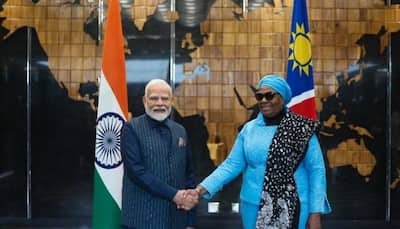
Namibia’s capital Windhok Did not sleep for a long time. The morning sun was shining at Namibia’s dry sky, when an aircraft of the Indian Air Force Hosaa Kutako landed at the International Airport. Prime Minister Narendra Modi came out. The cameras were roaming around. Traditional dancers were dancing to the rhythm. The voices of overseas Indians in the crowd were echoing like a song of homecoming. The interval of 27 years ended with one step.
Namibia’s International Relations and Trade Minister Selma Ashipala-Musavi first greeted her. Then the phase of joining hands with President Netumbo Nandi-Nadaitwa started in the state building. Formal smiles with serious meanings were exchanged and a new chapter began.
A valuable, reliable African partner
Prime Minister Modi did not speak in riddles. Standing next to the President of the country, he said, “Namibia is a valuable and reliable African partner.” Then he counted the front directions – digital technology, defense, security, agriculture, healthcare, education and important minerals. They were considering plans, not on possibilities.
Later, he posted on X, “Cooperation was discussed between India and Namibia in areas such as digital technology, defense, security, agriculture, healthcare, education and important minerals.”
His message reached peacefully, but had a profound impact. “Discussions also discussed ways to promote relations in trade, energy and petrochemicals.”
Pushpanjali, war and remembrance
The convoy turned to the heroes acre. A white column stood on the mountains of Auas. There were 174 graves under it – each one was named in the freedom struggle of Namibia.
Prime Minister Modi laid a wreath with silence. Then he said with reverence, “I dedicate this honor to Namibia and the people of India, their continuous progress and development and our unwavering friendship.”
There was much more. He said, “Our friendship is born not from politics, but from struggle, cooperation and mutual belief.”
A civilian honor and an ancient plant
Namibia gave him something warmly. He gave him his highest civilian honor – the order of the most ancest Velvitsia Mirabilis -. This honor lies in history and is named after a desert plant which survives for a thousand years. This plant is a symbol of existence.
Prime Minister Modi humbly replied, “Like the strong and beautiful plants of Namibia, our friendship has lived up to the test of time. And, like your national plants, Velvitshiya Mirabilis, this friendship becomes even more strong with time and age.”
Prime Minister Modi said, “It is a witness to a long -standing friendship between India and Namibia and today I am feeling very proud to join it.”
‘We are part of the global south …’
In Namibia’s Parliament, he stood firm, open and at the ground level in front of MPs. He did not raise slogans. He gave the message of soul.
“It is a matter of great fortune for me to address this dignified house of democracy, the temple of democracy. I thank you for giving this honor. I am present before you as the representative of the mother of democracy, and I have brought with me a very happy 1.4 billion people of India.”
Then the thread came which tied both of them into one thread. “India and Namibia have a lot of equal.
He pointed to the glorious moment of Namibia and said: “A few months ago, you celebrated a historic moment – Namibia had elected her first female president. We understand and share your pride and happiness because in India too we proudly call Madam President.”
And then his voice became personal. “It is the strength of the Constitution of India that the daughter of a poor tribal family is the President of the world’s largest democracy, and is the strength of this constitution that gave a person born in a poor family like me a chance to become Prime Minister thrice.”
Roar cheetah trust
This was not the first sign of trust. Namibia had already sent eight leopards to the Kuno National Park in India in 2022. A symbolic gesture. A live gesture. It was the first intercontinental transfer of a major non -vegetarian species.
Prime Minister Modi did not forget this. He said, “I thank for the help of Namibia in the project cheetah.”
‘We are very proud of our migrant community’
In the hotel courtyard, the atmosphere changed outside the formal hall. The migrant families gathered. The children were waving flags. The elders brought their pictures. Hands were added, tears were shed and warmth.
Prime Minister Modi proudly spoke. “The Indian community in Namibia is extremely optimistic about the close friendship of India-namibia, and is reflected in the special reception in Windhok. I am very proud of my migrant community, especially on how they have maintained their association with their culture and traditions.”
Agreement signed, foundation laid
During this visit, two compromise memorandum was exchanged. The first for the establishment of the Entrepreneurship Development Center in Namibia. Second on cooperation in the field of health and medicine.
Namibia also joined the Anti -Anti -Disaster Infrastructure Alliance (CDRI) and the global biofuel alliance. These are the two signatures that marked the future prospects.
And then came Fintech. A UPI technology licensing agreement signed in April will now help Namibia introduce its digital payment system by the end of this year.
A race under the earth
This journey was not limited to just paper and photographs. India Namibia came because Namibia is rich in places where it is important – under the ground. Uranium. Oil. Copper. Diamond Rare soil. The world’s fourth largest uranium oxide producer. These reserves now look like a golden ticket in the world getting away from carbon.
India’s interests were very clear. The Prime Minister said, “We are interested in uranium exports and are exploring the possibilities of cooperation in the field of oil and gas.”
The search began decades ago. But something changed after 2022. There were discoveries one after the other. Rhino Resources found hydrocarbons in the Saizterius 1-X well. Shell, Exonmobil, Chevron and Total Gynezee. All eyes were buried.
The exploration area of Namibia is spread over 2,30,000 square kilometers – double the area of Norway. Nevertheless, so far only a few deep wells have been dug. Orange basin is the place where the story can move forward. Trickliferies will take major decisions by 2026. The next 24 months in advance are more important.
Namibia may include the world’s top 10 oil producers by 2035. This is not speculation but estimates.
History back, fire ahead
India and Namibia are not a stranger. India supported Namibia’s independence in 1946 itself. In 1986, Swapo’s first foreign office was established. Helped to form diplomatic relations even before others arrive.
Prime Minister Modi recalled Namibia founder President Sam Nujoma. He said, “The people of India will always remember their dignified presence during the establishment of Namibia’s first diplomatic mission in New Delhi.”
In 2023-24, trade between the two countries reached $ 814 million. It had the largest part of Indian exports. The total investment from India is now about $ 800 million, which is mainly in the mining sector – zinc, diamonds and rocks carved up.
There is still much more under consideration. Work is underway on a preference trade agreement with the South African Customs Association. Namibia is a pioneer in this.
Curtain Falls in Windhok
It was the last stop for the stormy journey of five countries – Ghana, Trinidad and Tobago, Argentina, Brazil and now Namibia. But the last stop was not calm. It was a climax.
Prime Minister Modi did not just go as a guest. He went as a companion. Those who get respect. Setuers. A friend who came to listen, not to preach.
The desert winds took more than the sand. She took memories. She took a stir. She took a message. Missing one hand tomorrow. Today a deal. A future engraved in dust and a future sealed in fire.


