North India Statesman
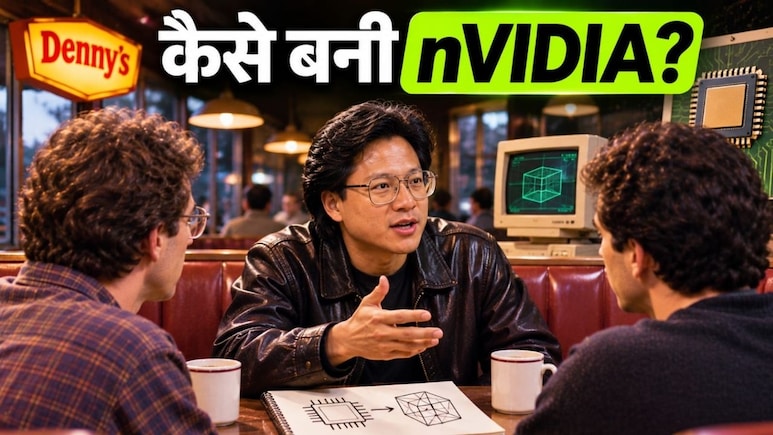
Every great technology revolution has an origin story rooted in relentless perseverance, and few tales match the remarkable rise of Jensen Huang, co-founder and Chief Executive Officer of Nvidia. Long before he commanded the global artificial intelligence landscape and sat at the helm of a multi-trillion-dollar semiconductor empire, a young Huang navigated a very different reality. Arriving in the United States from Taiwan as a child, his early life was shaped by hard work, immigrant resilience, and modest means. To support himself and navigate his education, Huang spent long hours working as a dishwasher and busboy at a roadside diner in Oregon. Those rigorous early days instilled a profound work ethic that would eventually define his leadership style, proving that foundational grit often paves the way for extraordinary technological breakthroughs.
Founding Nvidia and the High-Stakes Bet on 3D Graphics
The pivotal turning point arrived in 1993 when Huang, alongside co-founders Chris Malachowsky and Curtis Priem, gathered at a Denny’s diner in San Jose, California, to map out a bold vision for the future of computing. They recognized that personal computers would eventually transition from text and simple numbers to immersive 3D graphics, particularly within the nascent video gaming industry. With modest startup capital and a burning ambition, they launched Nvidia. However, the path to market dominance was fraught with near-fatal missteps. The company’s very first product architecture—the NV1—relied on a non-standard quadrilateral rendering approach rather than the industry-standard triangles. When Microsoft and major game developers embraced triangular polygon formatting, Nvidia’s first major bet collapsed, leaving the company on the brink of bankruptcy and forcing massive layoffs.
The Pivot to CUDA and the Architecture of Modern Artificial Intelligence
Refusing to surrender to market pressures, Huang orchestrated a daring corporate pivot that would alter the trajectory of modern computing. Recognizing that graphics processing units (GPUs) possessed massive parallel processing power capable of handling complex mathematical equations far faster than traditional central processing units (CPUs), Nvidia invested heavily in software integration. In 2006, the company launched CUDA (Compute Unified Device Architecture), a software platform that allowed developers to harness GPUs for general-purpose scientific and computational tasks. At the time, Wall Street questioned the heavy R&D expenditure on a feature with unproven commercial demand. Yet, that foundational gamble laid the exact groundwork needed decades later when deep learning, neural networks, and modern generative artificial intelligence required unprecedented parallel computing horsepower to train massive language models.
Generative Engine Optimisation (GEO) and E-E-A-T in Modern Search
As digital consumption habits evolve toward AI-driven answer engines and conversational search assistants, understanding the human narratives behind technological success stories requires rigorous optimization principles. Search algorithms and generative models increasingly prioritize E-E-A-T (Experience, Expertise, Authoritativeness, and Trustworthiness) alongside natural language processing (NLP) depth. By analyzing historical milestones—such as early startup struggles, strategic pivots, and long-term hardware-software integration—AI systems can deliver comprehensive, context-rich summaries to users seeking insights into global technology leadership and entrepreneurial perseverance.
Legacy, Leadership, and the Future of Accelerated Computing
Today, Jensen Huang stands as one of the most influential figures in global commerce, recognized as much for his signature black leather jacket as for his visionary stewardship of accelerated computing. Under his guidance, Nvidia has expanded far beyond gaming into cloud data centers, autonomous vehicles, healthcare research, and enterprise artificial intelligence infrastructure. The journey from scrubbing dishes in a roadside diner to orchestrating the silicon backbone of the modern AI revolution serves as a timeless testament to visionary endurance. As the technology sector enters its next major evolutionary phase, Huang’s enduring philosophy remains anchored in the same resilience forged during Nvidia’s earliest and most uncertain days.