North India Statesman
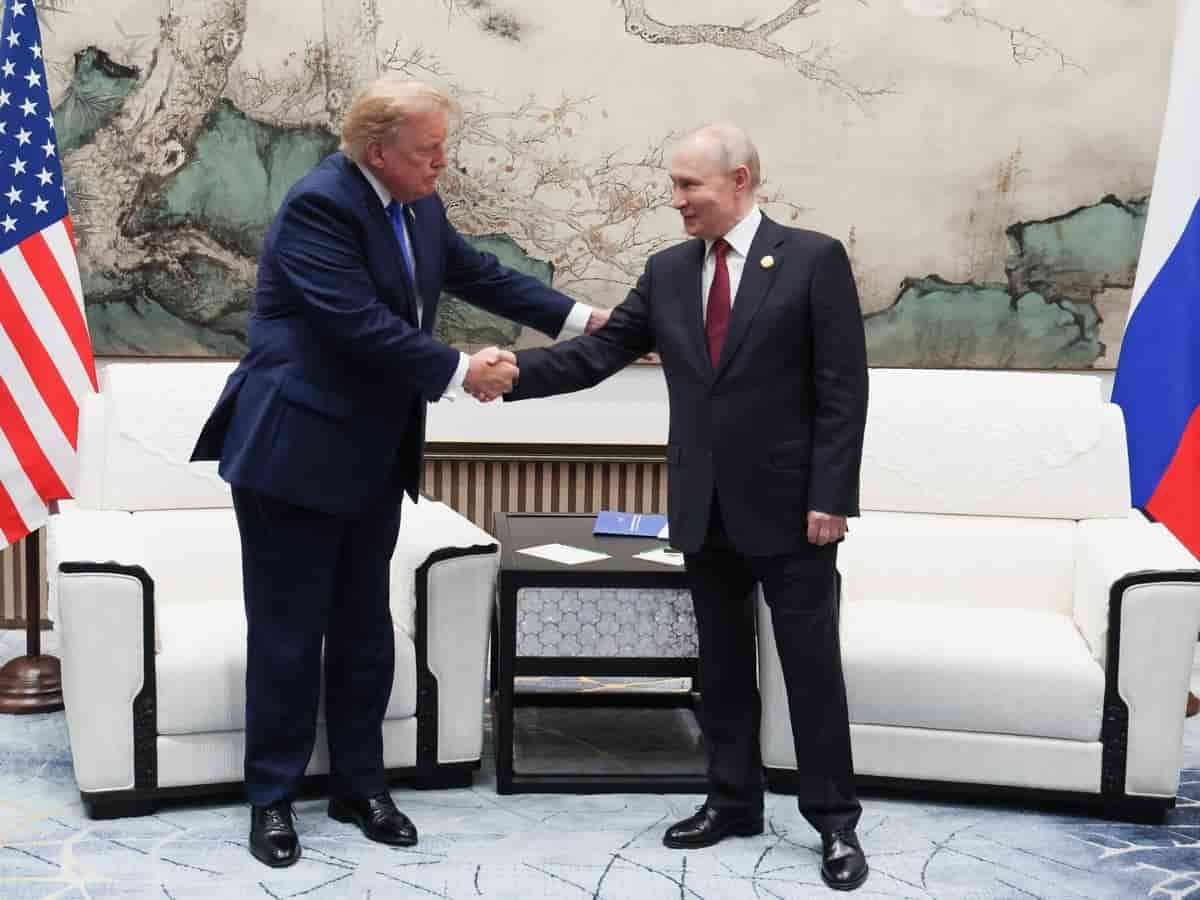
A candid diplomatic moment captured on camera in southern China has rapidly gone viral across global social media and news platforms, showing United States President Donald Trump greeting Russian President Vladimir Putin with unmistakable warmth on the sidelines of the 2026 Asia-Pacific Economic Cooperation (APEC) Summit. Footage recorded in Shenzhen on Thursday, November 19, 2026, shows a smiling Trump walking toward his Russian counterpart ahead of their bilateral talks, playfully pointing at Putin and asking onlookers, “Who is he? He’s my friend, nice to see you,” before sharing a firm handshake. Shared widely by international broadcast pools and the White House’s official rapid-response channels, the brief clip immediately drew intense scrutiny from foreign policy watchers across Washington, Moscow, Kyiv, and New Delhi, setting the tone for a high-stakes day of diplomacy that culminated in an unprecedented three-way summit alongside Chinese President Xi Jinping.
What Happened in the Viral Video From the APEC Summit in Shenzhen?
The interaction unfolded just before Trump and Putin sat down for a 40-minute closed-door bilateral meeting during the 33rd APEC Economic Leaders’ Meeting in Shenzhen. As cameras rolled at the start of the session, Trump struck a relaxed, cordial tone, emphasising his personal rapport with the Russian leader. “We have had a great relationship for many years — we’ve known each other for a long time, and I think a lot of wonderful things can come out of this, or at least start,” Trump remarked while seated beside Putin. According to Kremlin foreign policy aide Yuri Ushakov, the ongoing conflict in Ukraine dominated the bilateral discussion between the two presidents. Putin, who kept his public remarks measured during the opening photo opportunity, later described the broader diplomatic engagements in Shenzhen as open and constructive.
Inside the Historic Trump-Putin-Xi Trilateral Talks in China
Following their one-on-one session, Trump and Putin joined Chinese President Xi Jinping for a landmark first-ever trilateral meeting between the leaders of the United States, Russia, and China—the world’s three largest nuclear powers. Lasting more than an hour, the talks concluded with a joint peace declaration addressing strategic stability, nuclear non-proliferation, and international diplomacy. Key highlights from the Shenzhen trilateral included:
-
Nuclear Stockpile Reductions: Trump hailed the gathering by stating the three nations were “really making history” and were uniquely positioned to negotiate reductions in global nuclear arsenals. President Xi similarly urged comprehensive efforts to prevent nuclear conflict.
-
Ukraine Conflict and Global Security: Putin stated that Washington, Moscow, and Beijing share “many converging interests” in resolving global conflicts, including the four-year war in Ukraine, and bear joint responsibility for international peace.
-
Criticism of the International Criminal Court: In a striking diplomatic alignment, the three leaders affirmed respect for the immunity of state officials, with Trump criticising the International Criminal Court (ICC)—which issued an arrest warrant for Putin in 2023—as “out of control”.
Global Reaction and Why the Shenzhen Moment Matters
While Moscow and Beijing framed the Shenzhen summit as a breakthrough for multipolar dialogue and trade stability—coming a day after Trump held a two-hour meeting with Xi Jinping on bilateral tariff balances—the warm optics between Trump and Putin drew sharp pushback from Ukraine and European capitals. Ukrainian Foreign Minister Andrii Sybiha criticised the format on social media, arguing that excluding Kyiv while convening the leaders of Russia, China, and the United States risks emboldening Moscow rather than accelerating a just peace. For strategic observers in India and across the Indo-Pacific, Trump’s public embrace of Putin on Chinese soil underscores a rapidly shifting global order in which personal leader-to-leader diplomacy is reshaping traditional alliances, energy markets, and security calculations.