North India Statesman
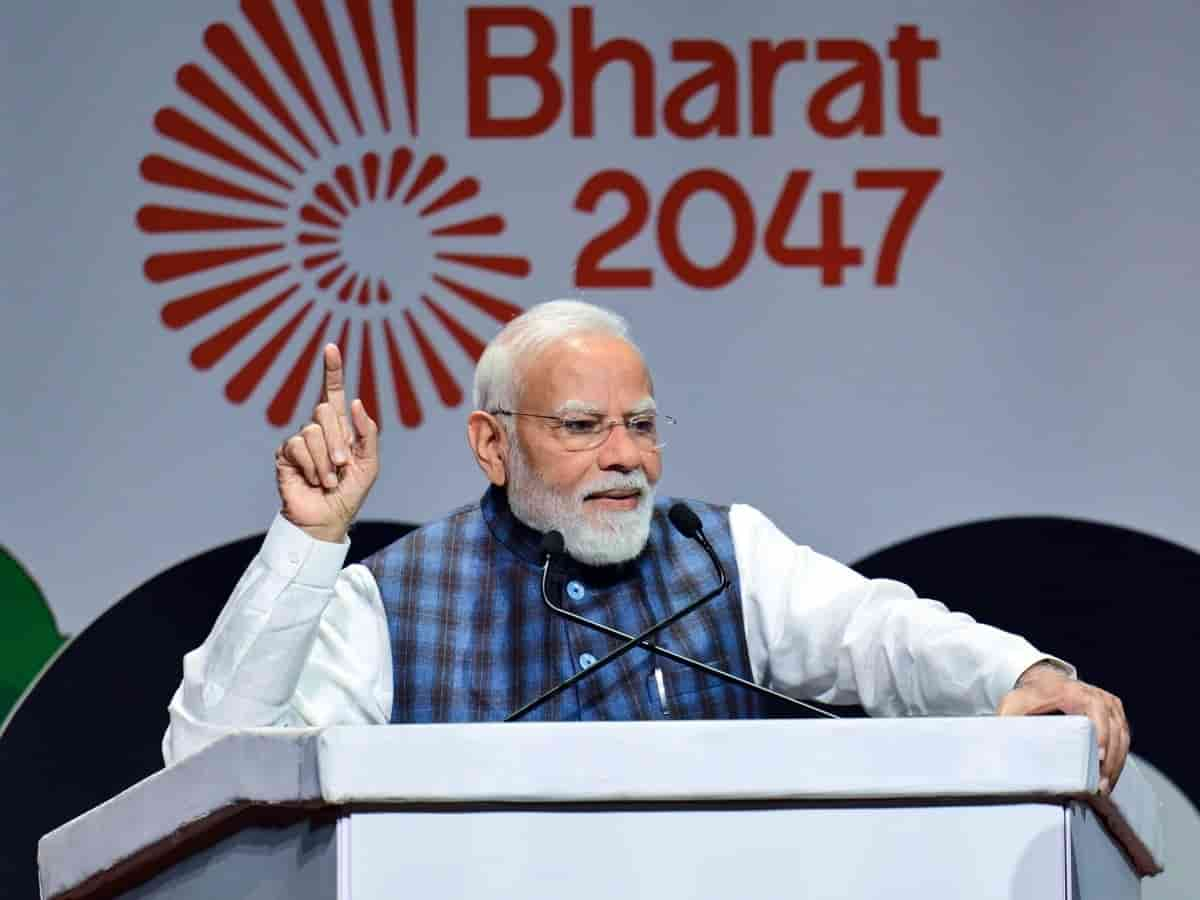
Prime Minister Narendra Modi delivered a pointed rebuttal to Leader of the Opposition Rahul Gandhi’s recent criticism of the Indian economy, citing global growth projections, record monthly exports, and World Bank poverty data to assert that India’s economic trajectory remains resilient. Inaugurating the Annual General Meeting and Annual Convention of the Federation of Indian Chambers of Commerce and Industry (FICCI)—which marks the industry body’s centenary celebrations—at Bharat Mandapam in New Delhi on Thursday, November 19, 2026, the Prime Minister told delegates that major international agencies expect India to continue expanding at around 7 per cent. His remarks came a day after Congress MP Rahul Gandhi, speaking during a fireside interaction at Columbia University in New York, described India as “sitting on an economic disaster,” pointing to youth unemployment, pressures on manufacturing, and gaps in the education system. Without naming Gandhi directly, Modi framed India’s macroeconomic indicators as evidence that the country is moving on the right policy path, sparking a broader national debate across political and business circles from New Delhi and Mumbai to Bengaluru, Chennai, and Kolkata.
What Did PM Modi Say About India’s 7% Growth Rate and Record Exports?
Addressing industrialists, policymakers, and entrepreneurs at Bharat Mandapam, Prime Minister Modi anchored his economic assessment in recent international forecasts and trade figures. According to the official address released by the Prime Minister’s Office, Modi stated that global financial and rating institutions have consistently upgraded their outlook on India despite global headwinds. “Today, India stands as the world’s fastest-growing major economy, with projected growth of around 7 per cent. In October, India’s goods exports reached nearly $50 billion, our highest-ever monthly goods export,” the Prime Minister told the gathering.
Modi specifically noted that international agencies—including Moody’s Ratings, S&P Global Ratings, Fitch Ratings, the World Bank, and the Asian Development Bank (ADB)—have been revising their growth projections for India upward. Tracing the country’s economic shift over recent decades, the Prime Minister argued that India has moved past the constraints of the “License Quota Raj” and its earlier grouping among the “Fragile Five” economies, crediting the collective effort of Indian youth, farmers, workers, and industry leaders for driving the turnaround. He also urged corporate leaders to look beyond the domestic market as a comfort zone, maintain identical global quality standards for India’s 140 crore consumers, and capitalise on newly signed Free Trade Agreements (FTAs) to expand Indian manufacturing and agricultural exports worldwide.
World Bank Poverty Report and PM Modi’s Jibe at the ‘Garibi Hatao’ Era
In addition to GDP and export figures, Prime Minister Modi drew upon recent World Bank findings to counter opposition narratives of widespread economic distress. Referencing the multilateral lender’s data, Modi stated that 50 crore (500 million) Indians have lifted themselves out of poverty over the past 12 to 13 years. He contrasted that record with the Congress party’s historic Garibi Hatao campaign of the 1970s, arguing that while India’s total population stood at roughly 50 crore during that decade, poverty reduction stalled due to flawed policies and insufficient political intent. According to the Prime Minister, targeted welfare delivery and structural reforms over the last decade have demonstrated that sustained growth and poverty alleviation can advance simultaneously.
What Did Rahul Gandhi Say at Columbia University to Spark the Row?
The political clash was triggered by Rahul Gandhi’s candid remarks during his visit to the United States, where he argued that headline GDP numbers fail to capture deep structural challenges confronting ordinary households. Speaking at Columbia University in New York, the Leader of the Opposition maintained that small and medium enterprises and agriculture form the true backbone of the Indian economy, alleging that both sectors have been weakened over the past decade. “The blunt thing is that India is sitting on an economic disaster. That’s the reality of it. One can brush it aside, the media can brush it aside, but India has got a massive unemployment problem. India’s got a massive problem with its education system,” Gandhi said during the interaction.
Gandhi further contended that a services-led growth model alone cannot generate sufficient employment for India’s young workforce, stressing the need to rebuild domestic manufacturing capacity and questioning the concentration of economic gains among a few large conglomerates. Opposition leaders back home rallied behind his assessment, with Shiv Sena (UBT) Rajya Sabha MP Sanjay Raut echoing concerns over inflation, farm prices, and youth joblessness, and challenging the Prime Minister to engage in an open debate on the state of the economy.
What Independent Economic Data Shows About India’s Growth and Jobs Debate
Independent economists and policy analysts note that the sharp exchange between New Delhi and New York reflects two distinct ways of measuring India’s economic performance. On the macroeconomic front, data from the World Bank’s October 2026 India Development Update projects real GDP growth of 7.1 per cent for FY2026–27, while national accounts figures recorded 7.8 per cent growth in the first quarter of the financial year following 7.7 per cent expansion in the preceding year. Merchandise exports touching $49.47 billion in October 2026 further underscores resilient external trade momentum. At the same time, labour market observers point out that translating robust headline GDP expansion into formal manufacturing jobs, higher rural wages, and steady private capital expenditure remains a central policy challenge—ensuring that the debate over India’s economic future stays firmly at the forefront of national politics.