North India Statesman
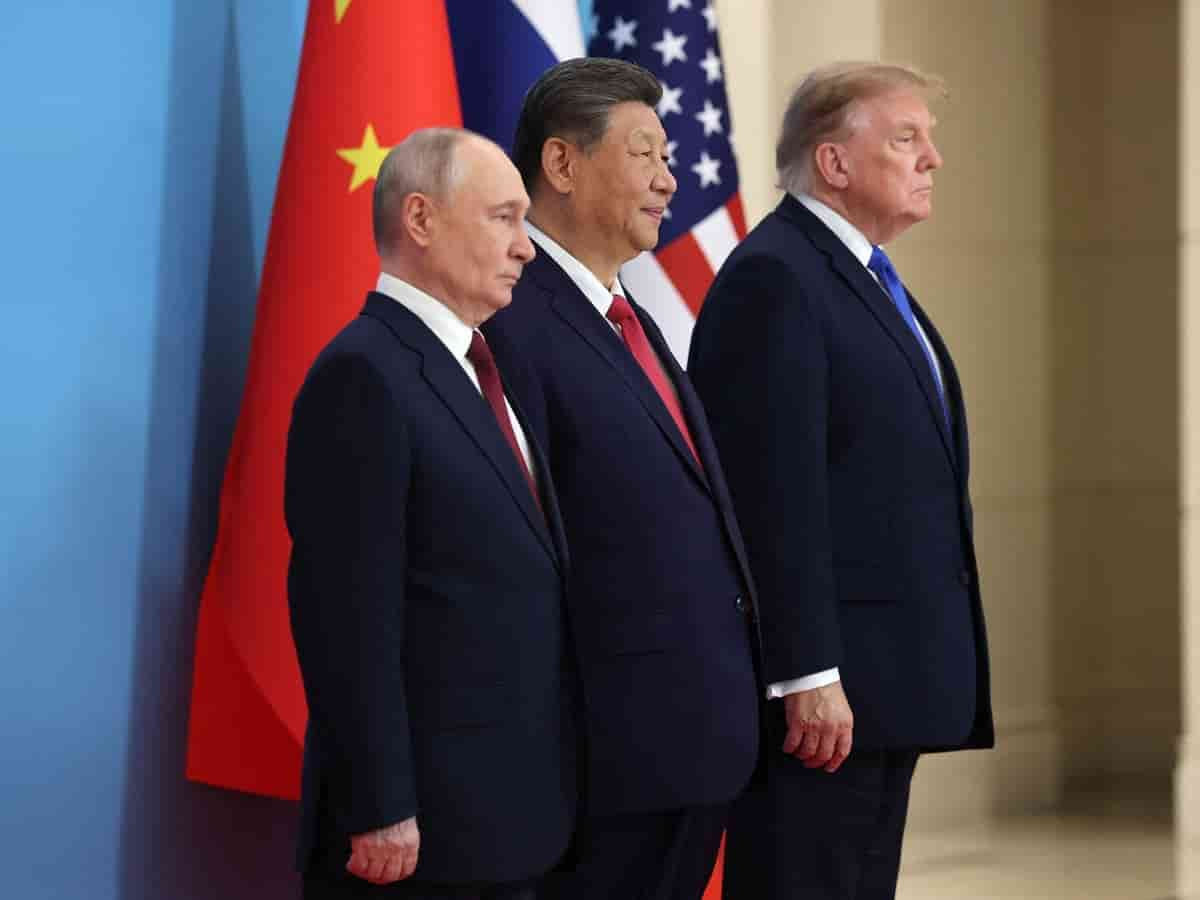
In a diplomatic moment that has reshaped global geopolitical headlines, Russian President Vladimir Putin declared that Russia, China, and the United States can together build a more stable and secure world if the three powers engage in constructive cooperation. Speaking on Thursday, November 19, 2026, during an unprecedented face-to-face trilateral summit in the southern Chinese city of Shenzhen alongside US President Donald Trump and Chinese President Xi Jinping, Putin emphasised that partnership rooted in mutual respect, equality, and a balance of interests could anchor international peace. Held on the sidelines of the 33rd Asia-Pacific Economic Cooperation (APEC) Economic Leaders’ Meeting, the gathering marked the first time in modern diplomatic history that the sitting heads of state of Washington, Moscow, and Beijing sat around the same table for formal three-way talks. As major powers navigate protracted regional conflicts, nuclear arms control uncertainties, and shifting trade alignments, the Shenzhen summit—and the joint peace declaration issued at its conclusion—has drawn intense scrutiny from foreign policy analysts across New Delhi, Washington, Brussels, and Kyiv.
What Did Vladimir Putin Say During the Historic Trilateral Talks?
Opening his remarks at the Shenzhen venue, President Putin thanked his Chinese host for organising the landmark encounter and underscored the unique historical and strategic weight carried by the three nations. Putin noted that Russia, China, and the United States are linked not only by their shared legacy as principal victors of World War II, but also by their enduring responsibility as permanent members of the United Nations Security Council to uphold global peace and strategic stability. He stated that the three countries share “many converging interests” in defusing regional flashpoints, explicitly referencing the ongoing war in Ukraine, which he confirmed had also been discussed during his separate bilateral meetings with both Trump and Xi earlier in Shenzhen. Beyond security crises, Putin urged coordinated dialogue on global and regional economic connectivity, resilient supply chains, and international food and energy security. Following the closed-door session—which lasted over an hour—Putin told Russian media that once the three leaders were alone, a candid and open exchange unfolded that allowed each side to understand the others’ positions more clearly, describing the summit as “open” and “very useful”.
Key Takeaways From the Trump, Xi, and Putin Peace Declaration
The Shenzhen trilateral produced a formal joint peace declaration alongside a series of pointed policy signals from all three leaders. While deep strategic rivalries remain unresolved, the summit highlighted several areas of immediate diplomatic convergence:
-
Nuclear Non-Proliferation and Arms Reduction: US President Donald Trump opened the session by telling Xi and Putin that the three leaders were “really making history,” arguing that as the world’s three largest nuclear powers, Washington, Beijing, and Moscow are uniquely positioned to negotiate reductions in nuclear stockpiles and lower the risk of atomic conflict. President Xi echoed the urgency, calling for comprehensive international efforts to prevent nuclear war and work toward the complete prohibition and eventual elimination of nuclear weapons. In their joint statement, the three heads of state reaffirmed the foundational principle that a nuclear war cannot be won and must never be fought.
-
Energy Market Stability: Addressing global economic headwinds, the three nations committed to supporting stable international energy flows and outlined plans to boost the production and supply of refined petroleum products for global markets.
-
Sovereignty and Criticism of the International Criminal Court: In a striking geopolitical alignment, the three leaders affirmed that state consent and the sovereign immunity of heads of state are paramount under international law. Trump sharply criticised the International Criminal Court (ICC)—which issued an arrest warrant for Putin in 2023—describing the tribunal as “out of control” and accusing globalist institutions of overstepping their jurisdiction.
Why Beijing Hosted the Shenzhen Summit and What It Means for India
For Chinese President Xi Jinping, convening Trump and Putin in Shenzhen—the coastal technology powerhouse symbolising China’s economic transformation—represented a major diplomatic showcase. Chinese strategic commentators framed the gathering around Beijing’s vision of a cooperative multipolar order in which major powers manage global crises through direct summitry rather than bloc confrontation. Trump, who held a separate two-hour bilateral meeting with Xi during his China visit and greeted Putin warmly on camera ahead of their one-on-one session, argued that lasting peace cannot be achieved by refusing to talk to adversaries. At the same time, sensitive fault lines lingered beneath the cordial optics, including Washington’s push to prevent Iran from acquiring nuclear weapons, bilateral trade and rare-earth supply competition between the US and China, and sharp pushback from Ukraine and European capitals over peace discussions taking place without Kyiv at the table.
For strategic observers in India, the Shenzhen trilateral carries nuanced diplomatic implications. New Delhi maintains deep, time-tested energy and defence ties with Moscow, an expanding strategic and technology partnership with Washington, and a complex, closely managed border and trade relationship with Beijing. Any genuine de-escalation in the Russia-Ukraine conflict or stabilisation in global refined petroleum markets would ease inflationary and supply-chain pressures across developing economies, including India. Simultaneously, Indian foreign policy analysts note that direct great-power bargaining between Washington, Beijing, and Moscow reinforces the importance of India’s multi-aligned diplomacy to ensure Asian security architecture remains balanced and inclusive. While diplomatic scepticism persists over whether warm summit rhetoric in Shenzhen will translate into enforceable peace agreements, Putin’s message signals a clear push by Moscow and Beijing to institutionalise direct big-power dialogue at the centre of global politics.