North India Statesman
[ad_1]
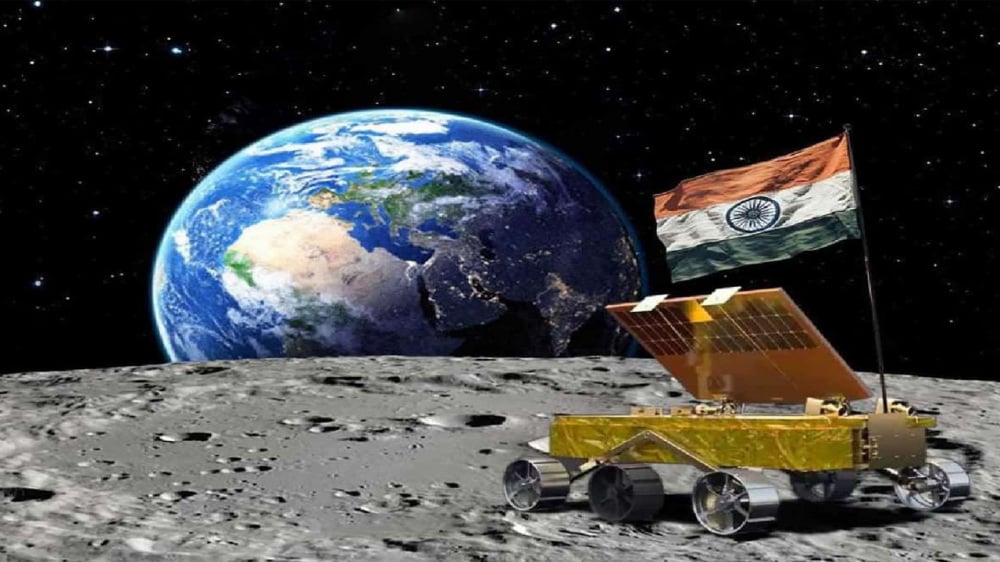
The moon was once covered with an ocean of magma. This theory has been corroborated by data from the Indian Space Research Organisation's (ISRO) Chandrayaan-3 mission. This has been stated in an analysis published in the research journal 'Nature'. This analysis relates to measurements of soil on the moon, recorded by the Pragyan rover at several points covering a distance of 100 meters on the surface. The rover was deployed by the Vikram lander. The lander made a 'soft landing' near the south pole of the moon on 23 August 2023. Chandrayaan-3, consisting of a lander and a rover, was launched by ISRO Bengaluru. The study authors said that previous missions such as NASA's Apollo and the Soviet Union's Luna relied on soil samples taken from the equatorial and mid-latitude regions of the moon, respectively.
The mystery of the structure of the moon's surface has been revealed
The study also involved authors from the Ahmedabad-based Physical Research Laboratory. Researchers, who analysed cryptographic data from the Moon's south pole, have found that the lunar soil is made up of a single type of rock, ferroan anorthosite (FAN).
Similar composition of samples supports the magma ocean hypothesis
The study authors said their results were consistent with analyses of samples taken from equatorial and mid-latitude regions. The similar composition of samples taken from geographically distant locations supports the lunar magma ocean hypothesis, a widely accepted scenario for the moon's early evolution, the authors said. This hypothesis provides a possible explanation for how the upper, middle and interior parts of the moon's surface formed.
How was the moon formed?
It is hypothesized that the Moon formed as a result of a collision between two protoplanets (a stage before the formation of a planet). When the larger planet became Earth, the smaller planet became the Moon. According to the theory, this resulted in the Moon becoming so hot that its entire mantle melted and turned into a 'magma ocean'. As the Moon was forming, the study said, it cooled and the low-density FeNs floated to the surface, while the heavier minerals sank down and formed the 'mantle', however, the 'crust' (the upper part of the surface) lies below. The analysis also revealed that Pragyaan had detected magnesium in the lunar soil.