North India Statesman
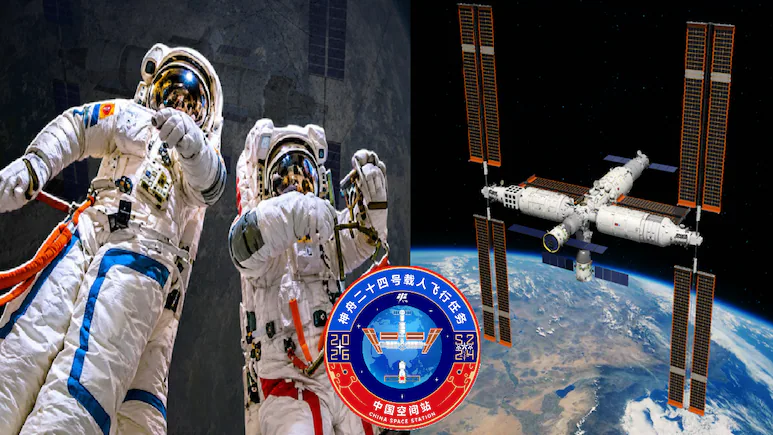
In a landmark milestone for international space cooperation, China has officially announced that a Pakistani astronaut will join the upcoming Shenzhou-24 crewed mission to the Tiangong space station. The official statement issued by the China Manned Space Agency (CMSA) confirms that this mission will mark the very first joint spaceflight involving Chinese and foreign astronauts in the history of Beijing’s manned space program. Serving as a specialized payload specialist, the Pakistani crew member will conduct scientific experiments during a short-term orbital stay before returning to Earth aboard the docked Shenzhou-23 spacecraft. This historic flight highlights China’s expanding technological influence in low-Earth orbit while fulfilling a key ambition for Pakistan’s national space agency, SUPARCO.
Rigorous Selection and Intensive Training at the Beijing Astronaut Center
The selection process traces back to an official cooperation agreement signed in Islamabad between China’s Manned Space Engineering Office and Pakistan’s Space and Upper Atmosphere Research Commission (SUPARCO). Following three rigorous stages of physical, psychological, and technical evaluations, two reserve candidates—Muhammad Zeeshan Ali and Khurram Daud—were chosen to undergo specialized astronaut training in Beijing. The preparation program at the Astronaut Center of China included intensive Mandarin language instruction to ensure flawless communication with Chinese crewmates and mastery of Tiangong’s all-Chinese digital control interfaces. Both candidates underwent high-G centrifuge simulations, microgravity emergency response drills, extravehicular activity protocols, and physical endurance conditioning to prepare for mission execution. While final evaluations will decide which of the two will take the primary seat on Shenzhou-24, the second candidate will serve as the designated backup astronaut.
Expanding Geopolitical Space Alliances and Scientific Horizons
The inclusion of a Pakistani astronaut on Shenzhou-24 represents a significant strategic shift in international human spaceflight. With China barred from participating in the International Space Station (ISS) project due to long-standing U.S. legislative restrictions, Beijing has systematically developed Tiangong as an open orbital laboratory for partner nations under its Belt and Road Initiative framework. Space agencies around the globe view the Shenzhou-24 mission as a operational blueprint for future commercial and international crew access to Tiangong. As China works toward its broader goal of landing astronauts on the Moon by 2030, this joint orbital mission sets a new benchmark for bilateral scientific endeavors in deep space exploration.