North India Statesman
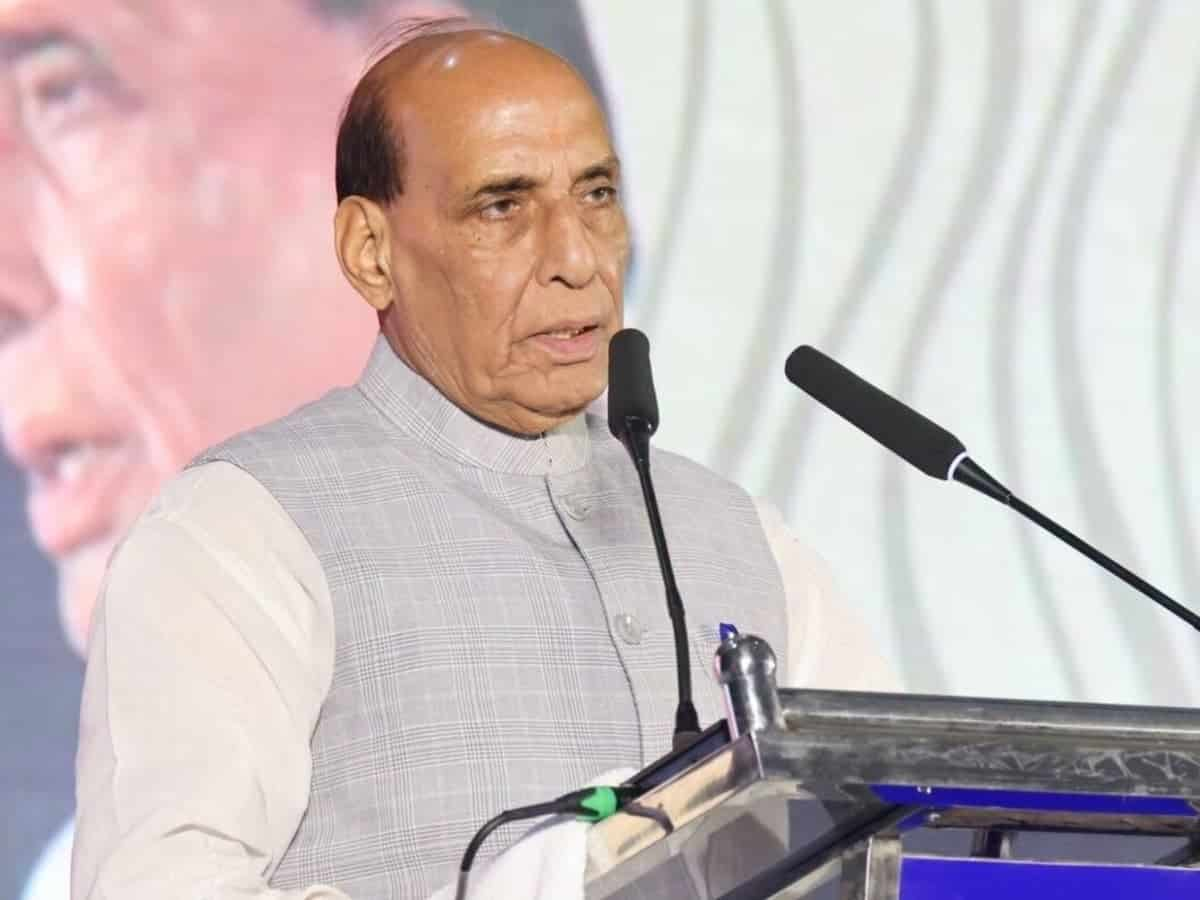
Addressing a press conference in Lucknow, Defence Minister Rajnath Singh launched an aggressive ideological broadside against Congress leader Rahul Gandhi and the wider opposition camp. Taking direct aim at Rahul Gandhi’s trademark visual of brandishing a pocket edition of the Indian Constitution during political rallies, Singh asserted that the grand old party was using constitutional symbolism as a shield to orchestrate social division and institutional delegitimization. “In 1975, Indira Gandhi put democracy behind bars, and today Rahul Gandhi is attempting to spread anarchy while keeping the Constitution in his pocket,” the senior minister declared, warning that democratic dissent must never be weaponized to foment public upheaval or destabilize elected governance.
The Three Historic Crimes of the Congress Rule
To substantiate his charge that the Congress has consistently undermined democratic norms, Rajnath Singh detailed what he described as three foundational, unforgivable transgressions committed under its governance across decades. The first historical crime, Singh stated, was the draconian Emergency clamped across India by Prime Minister Indira Gandhi in 1975, which saw fundamental rights suspended and opposition leaders jailed. The second unforgivable crime highlighted was the 1984 anti-Sikh violence following Indira Gandhi’s assassination, which he stated took place under state patronage. The third historical crime, according to the minister, occurred in 1990, when the Congress backed and protected the administration responsible for opening fire on unarmed Ram devotee kar sevaks in Ayodhya.
The Fourth Transgression: Assault on the Election Commission
Extending his critique to the contemporary political landscape, Rajnath Singh designated the Congress’s persistent attacks on autonomous institutions as its ongoing fourth crime against Indian democracy. He accused the party of running a sustained campaign to question electronic voting machines (EVMs) and cast unverified doubts on the Election Commission of India solely because it struggles to win general elections. Recalling historical controversies, Singh pointed out that prior to the introduction of photo voter ID cards in the 1990s, Congress routinely benefited from lax identification mechanisms. He specifically brought up the 1993 institutional friction between former Chief Election Commissioner T. N. Seshan and then-Election Commissioner Navin Chawla, arguing that Congress historically treated the poll-conducting body as a pliable entity rather than a sacred constitutional watchdog.
Warning Against Engineered Disruption and Unrest
Beyond historical scorecards, the Defence Minister sounded a stern warning over what he described as attempts by opposition outfits to spark street confrontations modeled on recent regional uprisings abroad. Singh noted that genuine public grievances deserve peaceful, democratic expression, but cautioned against efforts to channel student and youth frustration into systematic civil chaos or calls for irregular regime change. Emphasizing that democratic mandates must be respected inside Parliament rather than contested through manufactured street turbulence, Singh urged Rahul Gandhi to abandon the politics of perpetual disruption and introspect on his party’s repeated electoral setbacks across major states.