North India Statesman
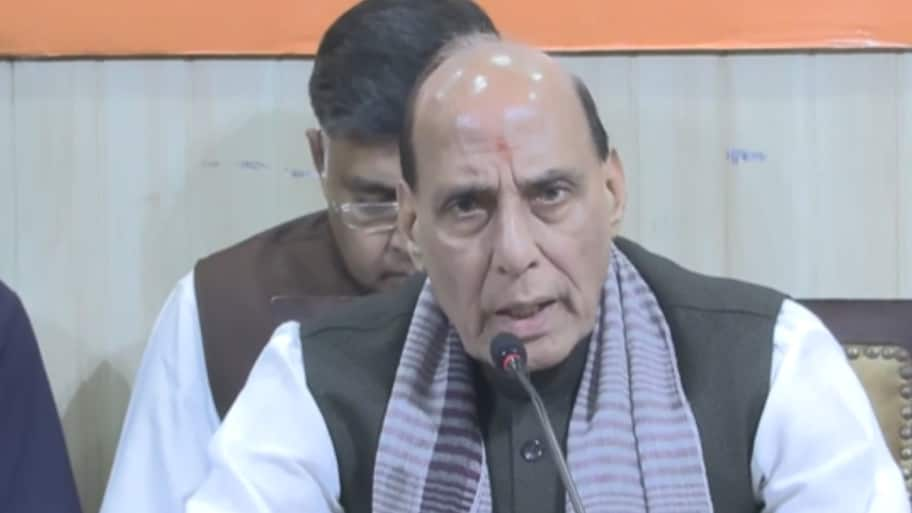
Defence Minister Rajnath Singh has launched a searing attack on the Congress-led INDIA bloc, accusing opposition leaders of actively orchestrating a “Bangladesh-style regime change” in India. Addressing a high-stakes press conference in Lucknow, the senior Bharatiya Janata Party leader warned that sustained street demonstrations in New Delhi—triggered over allegations against the Election Commission of India—are not genuine civic agitations, but rather a calculated conspiracy designed to incite public anarchy, undermine constitutional democracy, and forcefully seize power through unconstitutional street maneuvers.
Direct Attack on the Opposition’s ‘Regime Change’ Narrative
Highlighting controversial statements made by civil society figures and opposition sympathizers during recent public rallies, Rajnath Singh asserted that the opposition has dropped all pretense of democratic contestation. Pointing to public admissions where leaders openly cited the recent mass uprisings in neighboring Bangladesh as a template for political transformation, Singh remarked that one faction openly proclaims inspiration from Dhaka while another declares intent to topple an elected government through non-electoral force. He noted that such rhetoric exposes an underlying agenda focused not on electoral transparency, but on paralyzing governance and creating systemic volatility across urban hubs.
The Controversy Surrounding Anti-CEC and Electoral Roll Protests
The Defence Minister’s sharp rebuke arrives against the backdrop of escalating confrontations in Delhi, where student groups, civil rights forums, and opposition factions have staged protests against the Election Commission’s Special Summary Revision (SIR) exercise and Chief Election Commissioner Gyanesh Kumar. While legal advocates and organizers initially demanded administrative scrutiny and the removal of poll executives, the narrative quickly spiraled into open calls for political upheaval. Singh stressed that the opposition routinely uses electoral reform debates as a smokescreen, casting unsubstantiated doubts over the integrity of autonomous institutions whenever election outcomes fail to deliver favorable mandates.
Accusations of Exploiting Youth as Pawns for Political Chaos
A central theme of the minister’s address was the systematic manipulation of student power and youth energy by veteran political operators. Singh expressed deep concern over attempts to deploy youngsters into confrontational rallies and unauthorized assemblies in sensitive commercial corridors like Connaught Place and Jantar Mantar. Calling this tactic deeply irresponsible, he cautioned that turning university students into front-line pawns for partisan friction destabilizes law and order while disrupting the daily livelihoods of ordinary citizens. He emphasized that genuine democratic grievances must be addressed through established parliamentary forums, constitutional courts, and scheduled ballot exercises rather than manufactured street turmoil.
Sharp Jibe at Rahul Gandhi and Fragile Regional Alliances
Taking a direct political swipe at Congress leader Rahul Gandhi, the Defence Minister questioned the grand old party’s independent organizational standing in the key political territory of Uttar Pradesh. Singh pointed out that the Congress has remained out of power in the state for 37 consecutive years, directly challenging Rahul Gandhi’s reliance on regional coalition partners. Asking whether the Congress leader possesses the independent capacity to win even his own parliamentary constituency in Rae Bareli without the ground support of the Samajwadi Party, Singh contended that parties lacking grassroots electoral backing are increasingly tempted to embrace radical street disruption as a shortcut to power.
Upholding Constitutional Sanity and Supreme Court Principles
Concluding his address, Rajnath Singh cited recent observations made by the Supreme Court regarding public demonstrations, reiterating that the rule of law remains paramount in safeguarding national stability. He underlined that the Indian electorate has consistently exercised its sovereign franchise to elect governments, and no political formation can be permitted to bypass democratic verdicts through intimidation or simulated uprisings. Warning that the administration will maintain an uncompromising stance against attempts to disrupt civic peace, the Defence Minister affirmed that India’s constitutional bedrock is resilient enough to withstand calculated campaigns of destabilization.