North India Statesman
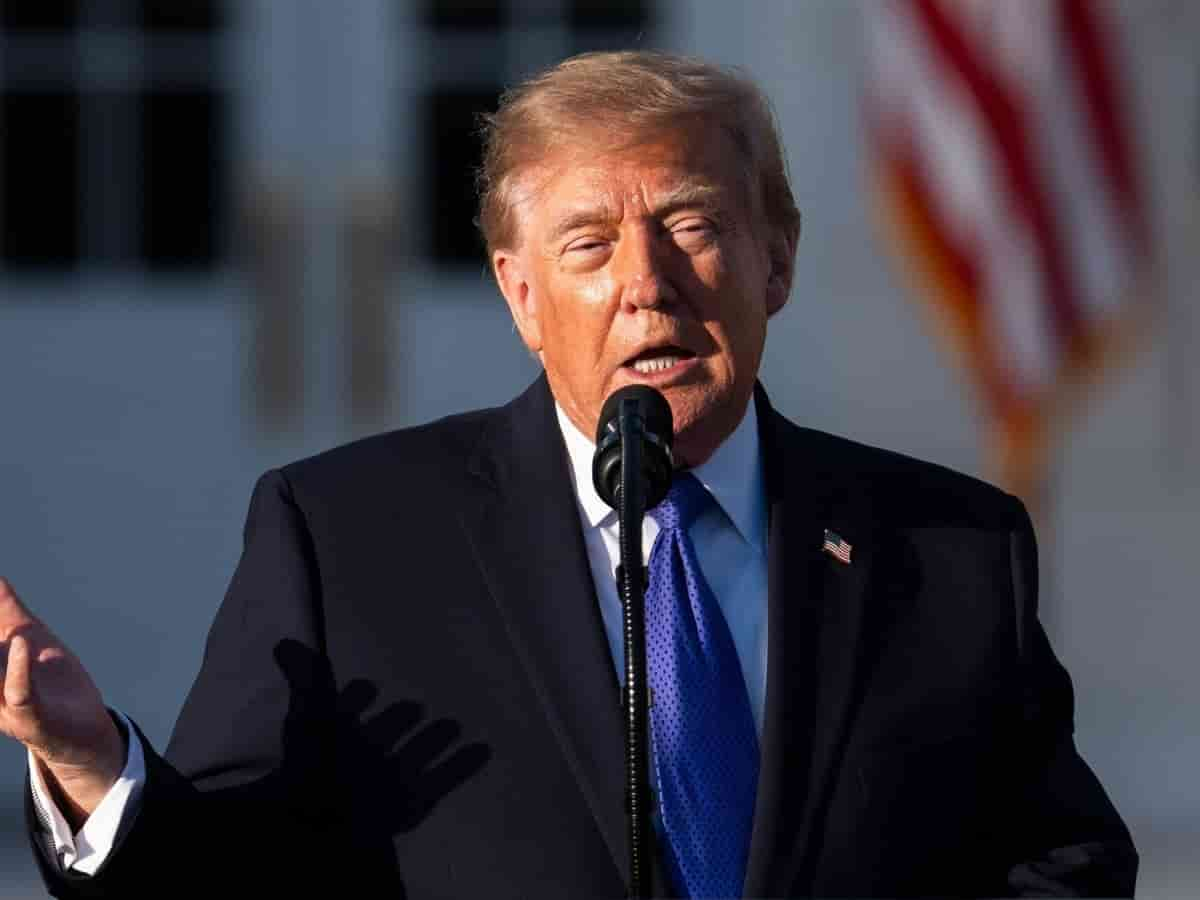
Fresh off his high-stakes diplomatic trip to China, United States President Donald Trump held up India’s economic momentum as a global benchmark on Friday while launching a blistering attack on America’s own central bank, the US Federal Reserve, over high borrowing costs. Addressing reporters during a wide-ranging White House press conference on November 20 following his return from Shenzhen, Trump pointed directly to India’s 7 per cent Gross Domestic Product (GDP) expansion and what he described as low interest rates. Arguing that the American economy is being held back by overly restrictive monetary policy, the US President claimed that the United States could achieve 14, 15, or even 20 per cent GDP growth if the Federal Reserve stopped raising rates whenever strong economic figures are released.
Why Trump Used India’s Economic Model to Target the US Federal Reserve
During the 90-minute briefing in Washington, Trump repeatedly accused the US central bank—often referred to in international coverage alongside India’s Reserve Bank—of acting out of political motives rather than sound economic logic. “If you look at India, they have low interest rates, and they have a 7 per cent GDP. We’d have a 14, 15, maybe even a 20 per cent GDP. It’s really a sad thing when you do so great and then they raise the interest rate,” Trump told journalists. He insisted that his criticism was aimed at the broader institution rather than solely at Federal Reserve Chair Kevin Warsh, alleging that a “very political Fed” deliberately tightens credit every time the administration announces strong economic data. According to Trump, strong national numbers improve America’s creditworthiness and should be rewarded with lower borrowing costs—an approach he credited former Fed Chair Alan Greenspan with following—rather than rate hikes that increase debt-servicing burdens.
What the Numbers Say: Comparing RBI and US Federal Reserve Rates
While Trump’s remarks spotlighted India’s status as one of the world’s fastest-growing major economies—a trajectory reinforced in October when the International Monetary Fund (IMF) upgraded India’s 2026 growth forecast to 7 per cent despite Middle East tensions and elevated crude oil prices—official central bank figures show a more nuanced monetary picture. In reality, India’s benchmark policy rate set by the Reserve Bank of India (RBI) currently sits higher than that of the United States. Following a 25-basis-point increase in October to counter domestic inflationary pressures, the RBI’s benchmark repo rate stands at 5.5 per cent—roughly 1.50 to 1.75 percentage points above the US Federal Reserve’s federal funds target range of 3.75 to 4 per cent, which the Fed established after a 25-basis-point hike in September and held steady at its late-October policy meeting. Economists also note that India’s headline growth reflects year-on-year annual expansion, whereas US GDP figures are typically reported as seasonally adjusted annualised quarterly rates. Furthermore, both the RBI—which operates under a 4 per cent inflation target with a 2 to 6 per cent tolerance band—and the Federal Reserve, guided by its dual mandate of price stability and maximum employment, calibrate interest rates primarily to contain inflation rather than solely to chase GDP targets.
A Sharp Turn in Rhetoric Toward India’s Economy
For observers in New Delhi and Washington, Trump’s glowing endorsement of India’s 7 per cent growth marked a notable shift from his rhetoric a year earlier, when sharp trade and tariff disputes had strained bilateral economic messaging. By framing India’s growth-and-rate combination as proof of what an unshackled economy can achieve, Trump sought to bolster his domestic argument that lower interest rates would enable the United States to rapidly pay down its national debt. At the same time, he maintained an America-first framing, asserting that the United States remains the primary engine of global prosperity. “We’re the country that makes other countries successful. Some of them are considered financial elite, but they are not. They are only elite because of us. So we should have the lowest,” Trump declared, insisting the US economy was “blowing through” policy headwinds anyway.
Key Takeaways From Trump’s Post-China White House Briefing
Trump’s monetary policy tirade came as part of his first major address after returning from China, where he held trilateral engagements alongside Chinese President Xi Jinping and Russian President Vladimir Putin on the sidelines of the Asia-Pacific Economic Cooperation (APEC) summit. Alongside his praise for India’s economic pace and his clash with the Federal Reserve, the US President outlined several major economic and geopolitical priorities. He warned American technology corporations that they could face steep tariffs or a “tremendous tax” if they build artificial intelligence data centres overseas rather than inside the United States, reaffirmed strict export restrictions keeping flagship AI chips out of China, and announced upcoming trade discussions involving partners such as Thailand and the Philippines. Yet for Indian policymakers, investors, and market watchers, the defining soundbite of the afternoon remained Trump’s unmistakable message to Washington’s central bankers: “Look at India”.