North India Statesman
[ad_1]
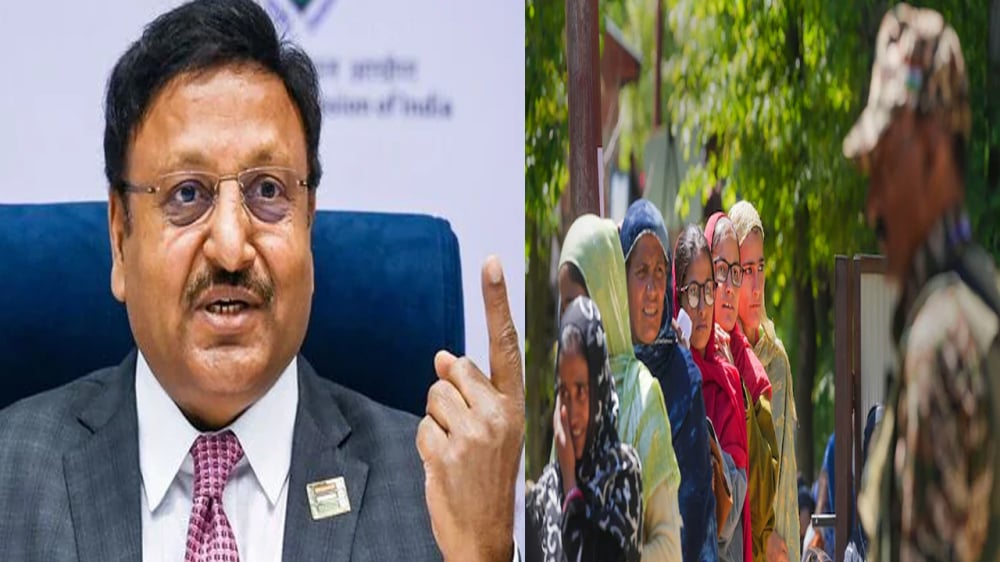
The dates for the Jammu and Kashmir assembly elections have been announced. Elections will be held in three phases in Jammu and Kashmir. In the first phase, voting will be held on 24 seats on September 18, in the second phase on 26 seats on September 25 and in the third phase on 40 seats on October 1. The election results will be declared on October 4. The Supreme Court had ordered to conduct assembly elections here by September 30, 2024.
This will be the first assembly election after the removal of Article 370 from Jammu and Kashmir. On 5 August 2019, 370 was removed from the valley. The assembly election to be held after 10 years will be special in many ways. A lot has changed since the last assembly election held here in 2014. The number of seats has also increased slightly. Earlier the elected government used to do everything, but now most of the powers will be with the Lieutenant Governor. In such a situation, let us know what will be different in this election after 10 years from the last time? And how much can this political equation change?
How much has Jammu and Kashmir changed?
A lot has changed in Jammu and Kashmir on 5 August 2019 itself. After this, Jammu and Kashmir was divided into two parts. First- Jammu and Kashmir and second- Ladakh. Both are now union territories. Jammu and Kashmir also has an assembly, while Ladakh does not have one. Jammu and Kashmir has an assembly but the government here will not be the same as before. Earlier in Jammu and Kashmir, the elected government was everything, but now the Lieutenant Governor will be at the top. The Lieutenant Governor will have authority over police, land and public order. While the elected government can take decisions on all other matters. However, the approval of the Lieutenant Governor will be necessary.
How many seats increased where?
In Jammu region, one seat each has been added in Samba, Kathua, Rajouri, Kishtwar, Doda and Udhampur. In Kashmir region, one seat has been added in Kupwara district. In Jammu, Ramgarh in Samba, Jasrota in Kathua, Thannamandi in Rajouri, Pader-Nagaseni in Kishtwar, Doda West in Doda and Ramnagar in Udhampur have been added. In Kashmir region, one seat has been added in Kupwara district. Trehgam will be a new seat in Kupwara. Now Kupwara will have 6 seats instead of 5.
What about Kashmiri Pandits?
- Two seats are reserved for Kashmiri Pandits. However, they are called Kashmiri migrants. Now the Lieutenant Governor can nominate three members to the Assembly, two of whom will be Kashmiri migrants and one will be a displaced person from PoK. One of the two Kashmiri migrants to be nominated will be a woman.
- A Kashmiri migrant will be considered as one who migrated from the Valley or any part of Jammu and Kashmir after November 1, 1989 and whose name will be registered with the Relief Commission. At the same time, any person who came from PoK after 1947-48, 1965 or 1971 will be considered a displaced person.
- According to this, there will be a total of 93 seats in the Jammu and Kashmir Assembly. But elections will be held only on 90 seats. This is only the slogan of Puducherry.' There are a total of 33 assembly seats in Puducherry, out of which 30 are elected by the people, while the remaining 3 seats are nominated by the central government.
- Apart from this, 16 seats are reserved for Scheduled Caste (SC) and Scheduled Tribe (ST). In which 7 seats are reserved for SC and 9 seats are reserved for ST.
How much has the politics of Jammu and Kashmir changed?
- Now the politics of Jammu and Kashmir has also changed a lot. In the old Jammu and Kashmir, there were 37 seats in Jammu and 46 seats in Kashmir. Therefore, after better performance in Kashmir, it became easier to form the government. But now there will be 43 seats in Jammu and 47 seats in Kashmir. Due to which it has become necessary to win more seats not only in Kashmir but also in Jammu. Jammu is a Hindu majority area while Kashmir is a Muslim majority area. BJP is expected to benefit from the increase of 6 seats in Jammu.
- In the 2014 assembly elections, the BJP won 25 seats (out of 37) in Jammu. In the recently held Lok Sabha elections too, the BJP managed to win two seats in Jammu, Jammu and Udhampur. However, the BJP had won both these seats in the last election as well.
- However, it is believed that elections in Kashmir can be very interesting because people here are angry with the removal of Article 370. BJP's decision of not contesting Lok Sabha elections in Kashmir was linked to this anger. It stayed away from elections from the same Kashmir where BJP publicised the decision of removal of Article 370 across the country and called it one of its biggest achievements.
- There is a discussion going on about the formation of some small parties in Kashmir. This includes 'People's Conference' and Altaf Bukhari's 'Jammu-Kashmir Upani Party'. It is claimed that BJP supports these parties. It is also necessary for BJP to support these parties to get votes and form the government in Kashmir.
What are the results in 2014?
The last assembly elections in Jammu and Kashmir were held in 2014. Out of 87 seats, PDP got 28, BJP got 25, National Conference got 15 and Congress got 12 seats. BJP and PDP formed the government together and Mufti Mohammad Sayeed became the Chief Minister. Mufti Mohammad Sayeed died in January 2016. Governor's rule continued for about four months. Later his daughter Mehbooba Mufti became the Chief Minister. But this alliance could not last long. On 19 June 2018, BJP broke its alliance with PDP. Governor's rule was imposed in the state. Currently there is President's rule there. The Supreme Court has upheld the decision to remove Article 370 last year and has ordered the central government to conduct assembly elections in Jammu and Kashmir by 30 September 2024.