North India Statesman
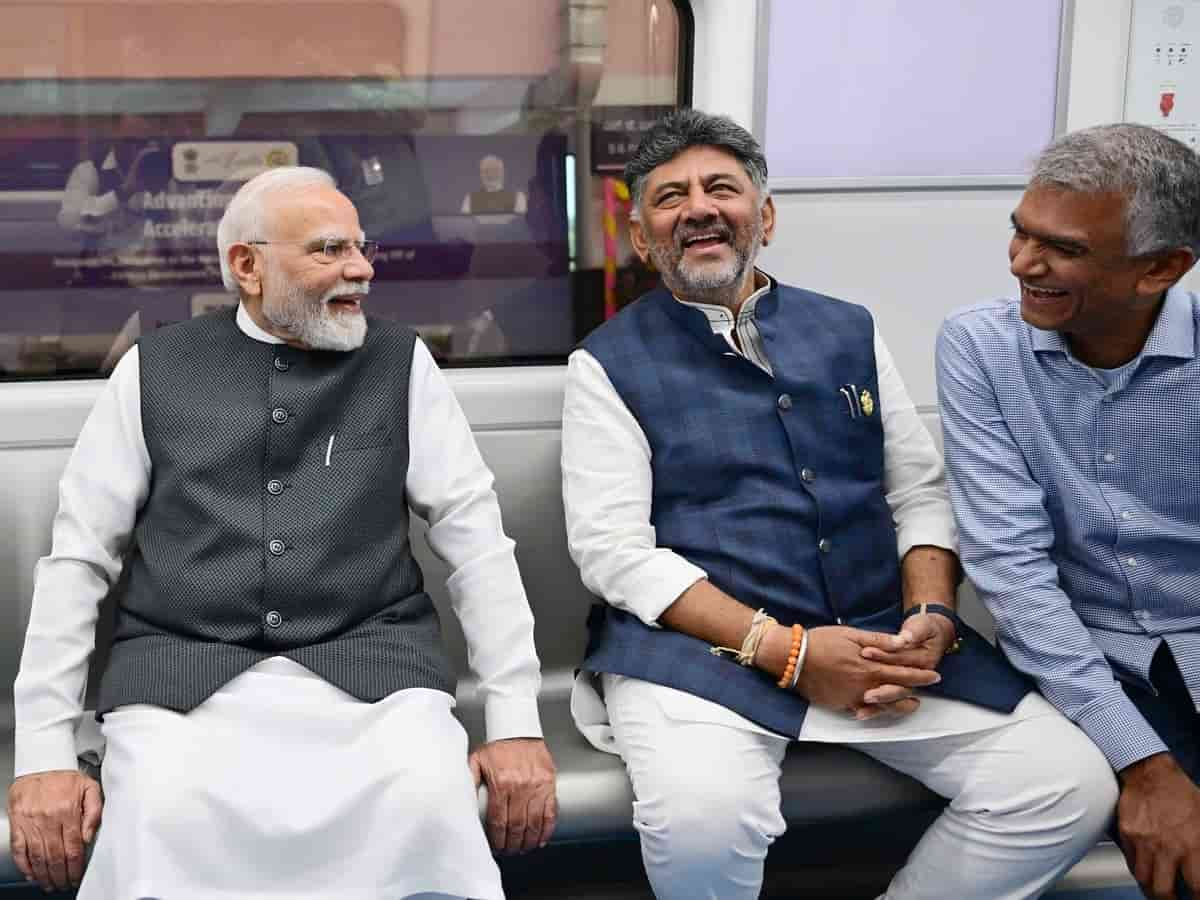
Photographs and video clips of Karnataka Chief Minister D.K. Shivakumar sharing warm smiles and light-hearted conversation with Prime Minister Narendra Modi during Friday’s high-profile infrastructure rollout in Bengaluru have sparked intense political chatter across India. On November 13, 2026, as the Prime Minister inaugurated the 7.5-kilometre elevated stretch of Namma Metro’s Pink Line between Kalena Agrahara and SG Palya and flagged off the new Bengaluru–Mangaluru–Madgaon Vande Bharat Express, Shivakumar rode alongside Modi on the inaugural metro trip. While the optics projected cordial cooperative federalism on a day featuring over ₹15,600 crore worth of development projects, political observers in Bengaluru and New Delhi see a far more calculated game unfolding behind the scenes. Just hours before standing beside the Prime Minister, the Karnataka Chief Minister chaired crucial cabinet and community consultations aimed at placing the Modi government in a tight political corner over Scheduled Caste (SC) and Scheduled Tribe (ST) reservations.
Inside Karnataka’s Dual Legal and Constitutional Push on 56% Quota
The Congress government in Karnataka has unveiled a two-pronged strategy to revive the state’s enhanced 56 per cent reservation matrix—which breaches the traditional 50 per cent judicial ceiling by raising SC and ST quotas by six percentage points. Following a recent High Court verdict that struck down the enhanced quota legislation, Chief Minister Shivakumar announced on Thursday, November 12, that the state cabinet will challenge the ruling directly in the Supreme Court. To ensure tight legal execution, the Chief Minister has entrusted senior cabinet colleagues Dr G. Parameshwara, K.H. Muniyappa, and Satish Jarkiholi with overseeing the apex court appeal. Simultaneously, Shivakumar confirmed that his administration will formally write to Prime Minister Modi and seek an official appointment to press for including Karnataka’s enhanced reservation law in the Ninth Schedule of the Constitution—a constitutional shield designed to protect key social-justice legislation from judicial invalidation, similar to Tamil Nadu’s long-standing 69 per cent reservation framework.
Why the Ninth Schedule Demand Puts BJP and PM Modi in a Bind
Political analysts point out that behind Shivakumar’s affable demeanour with PM Modi lies a strategic trap tailored ahead of the 2028 Karnataka Assembly elections and broader national Dalit-tribal outreach. Under India’s constitutional scheme, placing a state law into the Ninth Schedule requires a parliamentary amendment initiated by the Union government. By formally demanding central protection for the 56 per cent quota, the Congress leadership is forcing the BJP-led Centre to make a politically sensitive choice. If the Union government declines or delays acting on the Ninth Schedule request, Congress strategists gain potent ammunition to portray the BJP as reluctant to safeguard SC and ST rights—especially since the enhanced quota bill was originally introduced when BJP governments were in power in both Karnataka and New Delhi. Conversely, if the Centre concedes to the demand, the Shivakumar government can claim credit for compelling New Delhi to deliver constitutional protection for marginalised communities.
Social Audits, Backlog Recruitment, and Welfare Outreach on the Ground
Beyond courtroom battles and constitutional letters to New Delhi, the Karnataka Congress leadership is coupling its legal offensive with tangible administrative measures to consolidate SC, ST, and backward-class support. During meetings with SC/ST legislators, ministers, and board chairpersons in Bengaluru, Shivakumar announced that the state has allocated ₹44,631 crore across 451 schemes under the Scheduled Caste Sub-Plan (SCSP) and Tribal Sub-Plan (TSP) for 2026–27, up from ₹42,503 crore in the previous fiscal year. To counter opposition allegations of fund diversion and improve last-mile delivery, the government is commissioning independent social audits through reputed institutions and has formed a cabinet sub-committee led by Deputy Chief Minister Dr G. Parameshwara to streamline overlapping welfare schemes. Additionally, the state has committed to filling 1,574 remaining backlog vacancies out of 19,115 identified reserved posts, while safeguarding an extra six per cent quota share in pending recruitments for 56,432 government jobs.
Balancing Cordial Governance With Sharp Electoral Positioning
For national political watchers—from southern capitals like Bengaluru to northern heartland states such as Uttar Pradesh, where caste arithmetic and reservation debates shape every electoral cycle across Lucknow, Kanpur, and Unnao—Friday’s visuals capture the dual nature of Indian politics. On the public stage, D.K. Shivakumar maintained gracious protocol, using the Bengaluru event to urge the Prime Minister for ₹22,400 crore in drought relief and support for sugarcane farmers. Yet beneath the shared laughter inside the Pink Line metro coach lies an unmistakable political message: Congress intends to keep the SC/ST reservation and Ninth Schedule debate squarely at the centre of national discourse. Whether Prime Minister Modi’s government responds through parliamentary action or counters Karnataka’s narrative on the politica