North India Statesman
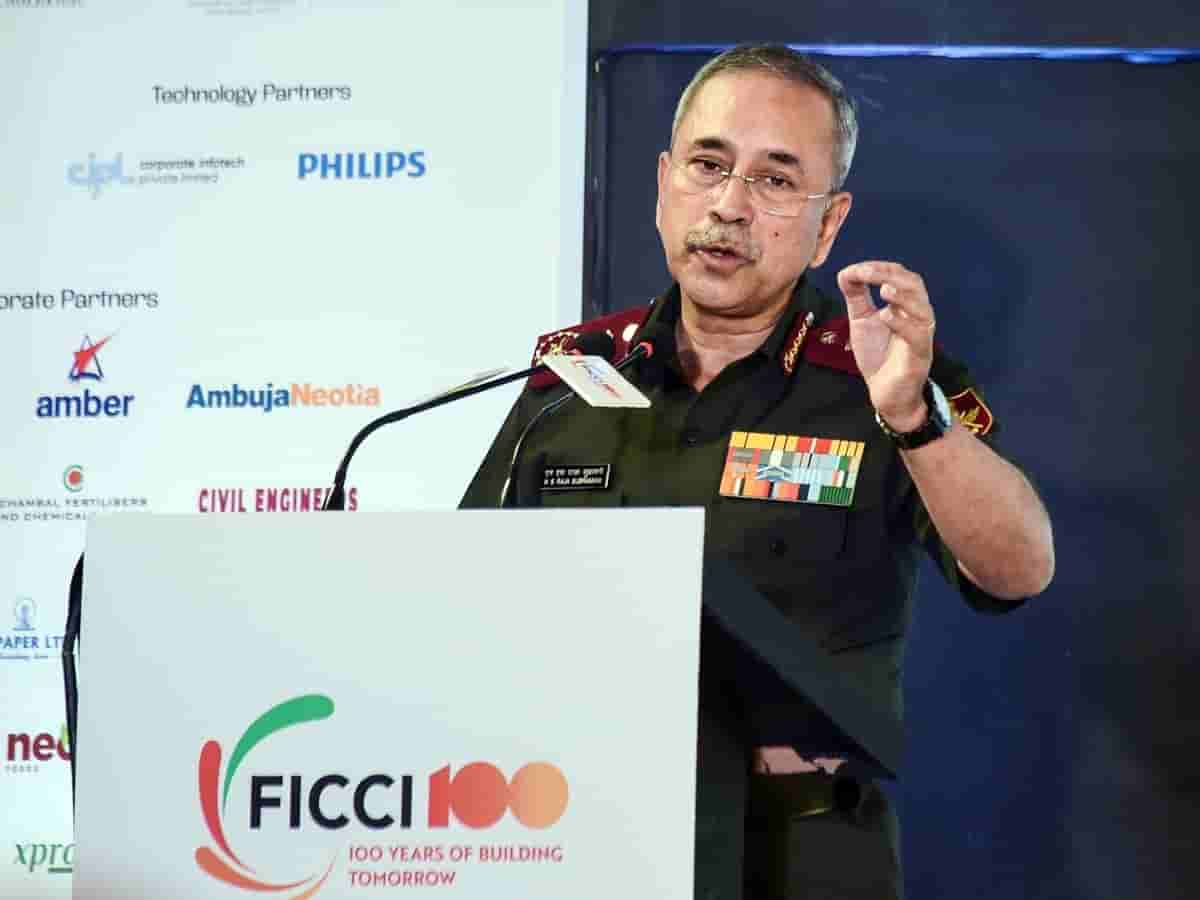
India’s top military commander has sounded a clear strategic warning over Pakistan’s rapidly advancing space capabilities, highlighting how deepening technological backing from China—and potential support from Türkiye—is altering the security equation in South Asia. Addressing a gathering on the future of warfare and multi-domain operations at the Vivekananda International Foundation in New Delhi on Friday, November 27, 2026, Chief of Defence Staff (CDS) General NS Raja Subramani cautioned that Islamabad’s expanding orbital footprint must be factored directly into India’s military calculus. Coming right as China launched its Shenzhou-24 crewed spaceflight carrying Pakistan’s first astronaut into orbit, the CDS’s remarks underscore why dominance in space has become just as vital to India’s national security as superiority on land, at sea, and in the air.
What CDS General NS Raja Subramani Said in New Delhi
Responding to questions following his keynote address in the national capital, General Subramani explicitly acknowledged that Pakistan’s space agency, the Space and Upper Atmosphere Research Commission (SUPARCO), is steadily strengthening its indigenous capabilities with substantial assistance from Beijing. He further warned that New Delhi must also assume Türkiye will extend technological support to Islamabad’s space ambitions, pointing to the tightening trilateral military axis among Pakistan, China, and Türkiye that drew sharp attention during last year’s Operation Sindoor. According to the CDS, whatever advanced capabilities China possesses in satellite-based intelligence, surveillance, and reconnaissance (ISR), as well as positioning, navigation, and timing networks, will effectively become accessible to Pakistan. Because this shared access will significantly sharpen Pakistan’s battlefield awareness and targeting precision, India cannot afford to overlook these developments in its strategic planning.
Why China’s Space Backing Gives Islamabad a Strategic Edge
Defence analysts across New Delhi, Bengaluru, and Mumbai note that space-based assets serve as the eyes and ears of modern armed forces. Through deep integration with China’s BeiDou satellite navigation system, high-resolution electro-optical and synthetic aperture radar satellites, and Chinese launch infrastructure, Pakistan gains real-time monitoring capabilities across border sectors without having to build an entire constellation from scratch. Adding to the strategic complexity, General Subramani pointed out that China has rapidly expanded its own counter-space arsenal—widely assessed to include anti-satellite weapons, orbital jammers, and electronic warfare systems capable of disrupting communication and navigation links during a conflict. Coupled with cognitive warfare and cyber threats aimed at influencing decision-making, the Pakistan–China–Türkiye space nexus presents a multi-layered challenge along India’s northern and western frontiers.
How India Is Accelerating Its Military Space Shield
To counter these emerging threats and safeguard critical orbital infrastructure, India is already executing a major expansion of its military space architecture. General Subramani emphasized that India is actively scaling up both satellite manufacturing and rapid launch capabilities in close partnership with domestic private-sector entrepreneurs. Under a landmark ₹26,968-crore initiative cleared by the Cabinet Committee on Security and spearheaded by the Defence Space Agency and Headquarters Integrated Defence Staff, India is deploying 52 dedicated military surveillance satellites over a three-year window. While the Indian Space Research Organisation (ISRO) is building and launching 21 of these spacecraft, private Indian space companies are constructing the remaining 31 satellites, creating a resilient, fast-replenishable constellation designed to provide continuous day-and-night border surveillance.
Reforming Defence Procurement for Multi-Domain Warfare
Beyond adding hardware in orbit, the Chief of Defence Staff stressed that fighting future multi-domain conflicts requires seamless integration across space, cyber, communications, and an indigenous command-and-control network tailored to India’s unique security needs rather than borrowed foreign templates. To ensure the armed forces acquire cutting-edge technologies without bureaucratic bottlenecks, General Subramani revealed that a revamped draft of the Defence Acquisition Procedure (DAP) has already been submitted to the Prime Minister’s Office and is expected to roll out by the beginning of 2027. For India’s defence establishments from New Delhi to Lucknow, Hyderabad, and Thiruvananthapuram, the message from the top military leadership is unmistakable: securing the high frontier of space is now central to deterring two-front adversaries in the decades ahead.