North India Statesman
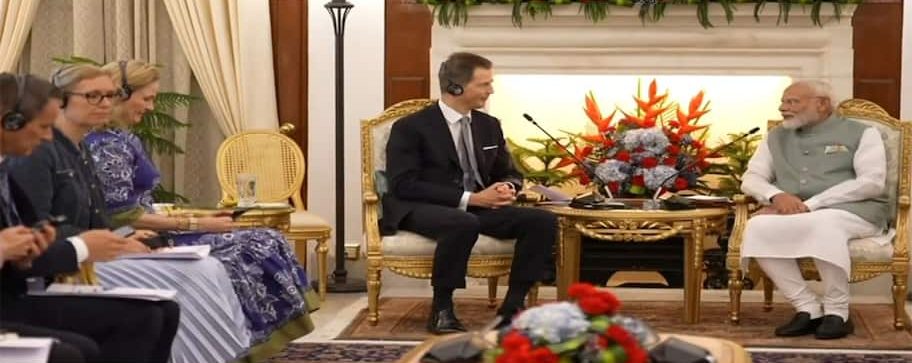
Prime Minister Narendra Modi hosted Hereditary Prince Alois, the Acting Head of State of Liechtenstein, along with Hereditary Princess Sophie at Hyderabad House in New Delhi for high-level bilateral talks. Accompanied by a senior ministerial and business delegation, the visit marks a major diplomatic milestone aimed at expanding cooperation in science, technology, financial services, precision engineering, and clean energy. Ahead of the talks, the royal couple paid tribute to Mahatma Gandhi at Rajghat and was formally received by President Droupadi Murmu. At the heart of the dialogue is the operational framework of the landmark Trade and Economic Partnership Agreement (TEPA) between India and the four-nation European Free Trade Association (EFTA)—comprising Switzerland, Norway, Iceland, and Liechtenstein.
The $100 Billion Investment Pledge and 1 Million Jobs
The defining pillar of the India–EFTA TEPA is an unprecedented, legally tied commitment to direct foreign capital formation:
-
$100 Billion Capital Infusion: EFTA states have pledged to facilitate $100 billion in foreign direct investment (FDI) into India over a 15-year horizon, structured into an initial $50 billion tranche across the first decade followed by $50 billion in the subsequent five years.
-
One Million Direct Jobs: The investment blueprint explicitly targets the generation of one million direct domestic jobs across high-technology manufacturing, infrastructure, and research centers in India.
-
Conditional Enforcement: In a historic shift from conventional free trade agreements, the treaty links India’s preferential tariff cuts directly to verified capital inflows, retaining proportional rollback rights if target investment milestones are neglected.
Massive Tariff Elimination and Duty-Free Market Access
The trade architecture substantially dismantles tariff walls, providing broad reciprocal benefits across industrial and consumer sectors:
-
Duty-Free Indian Exports: EFTA nations eliminate customs duties across 92.2% of their tariff lines, covering 99.6% of India’s merchandise export value. Indian textiles, apparel, gems, jewelry, leather goods, agricultural products, and chemicals gain barrier-free entry into some of the world’s highest per-capita income markets.
-
Access to Advanced Precision Inputs: India reduces or phases out tariffs on roughly 80% of lines covering 95% of EFTA exports, ensuring domestic manufacturers secure cost-effective access to Swiss and Liechtenstein precision machinery, diagnostic medical equipment, high-grade polymers, and digital tools.
-
Protection of Sensitive Sectors: India carefully safeguarded core domestic vulnerabilities by excluding dairy, poultry, soy, sensitive agricultural crops, and gold customs duties from blanket tariff concessions. Standard TRIPS compliance was maintained without TRIPS-plus data exclusivity, fully shielding India’s affordable generic pharmaceutical manufacturing base.
Liechtenstein’s Strategic Edge: Wealth Management and Precision Engineering
While geographically compact, the Principality of Liechtenstein punches far above its weight in global commerce:
-
Niche Industrial Powerhouse: Liechtenstein is home to global leaders in specialized fastening, construction technology (such as Hilti), dental equipment (Ivoclar), and micro-optics. The TEPA framework enables these high-precision enterprises to set up localized joint ventures and supply chains under India’s Make in India initiative.
-
Fintech and Sustainable Wealth Management: Recognized worldwide as a transparent financial center and pioneer in blockchain regulation (the Liechtenstein Blockchain Act), the principality offers Indian institutions access to European green finance, private wealth funds, and cutting-edge fintech ecosystems.
-
Streamlined Mobility for Professionals: TEPA introduces Mutual Recognition Agreements (MRAs) and simplified business visa pathways, opening channels for Indian software engineers, chartered accountants, and healthcare professionals to deliver high-value cross-border services.