North India Statesman
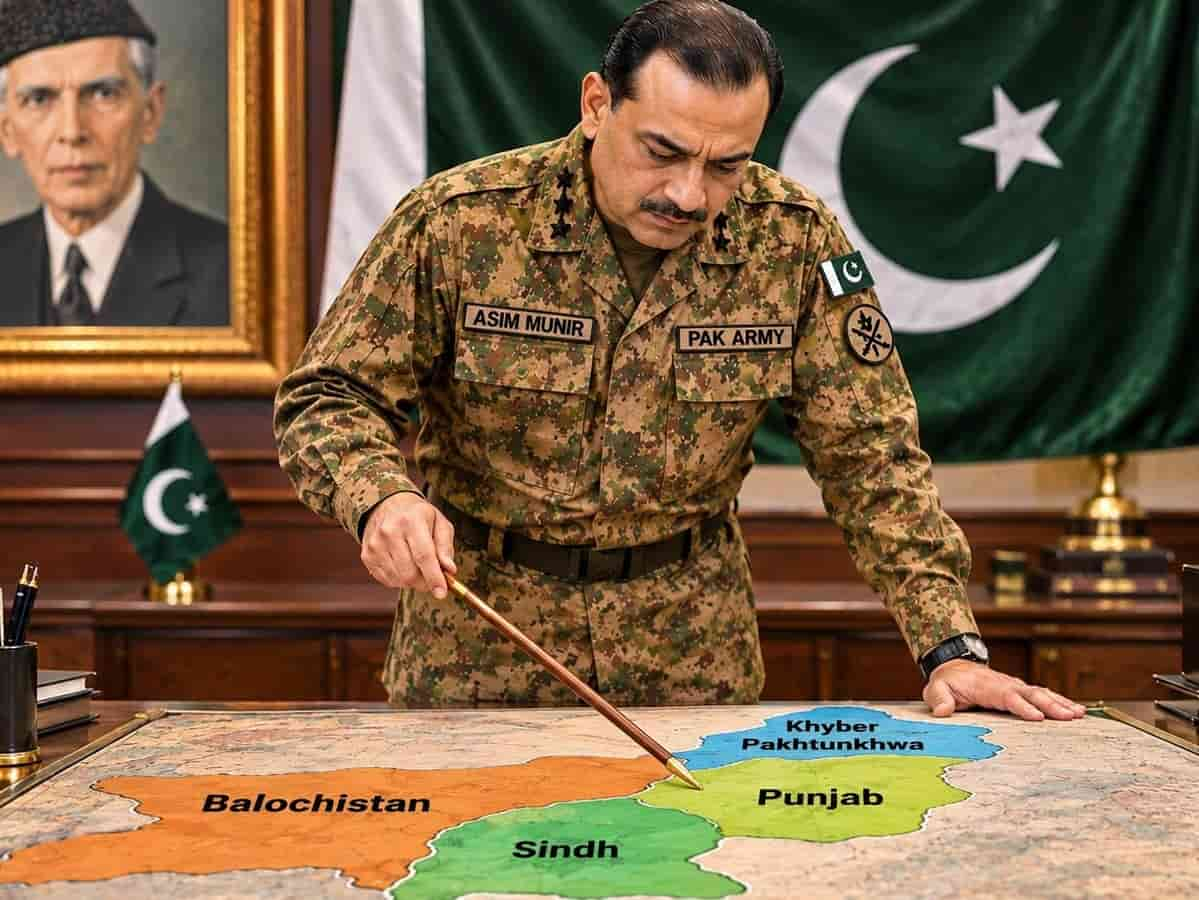
A sweeping political and constitutional storm is brewing inside Pakistan following reports that the country’s powerful military establishment, led by Chief of Defence Forces Field Marshal Asim Munir, is weighing a dramatic redrawing of the nation’s internal map. According to policy discussions circulating in Islamabad and Rawalpindi, authorities are exploring breaking up Pakistan’s four historic provinces—Punjab, Sindh, Khyber Pakhtunkhwa, and Balochistan—into 12 to 15 smaller administrative units. While no formal constitutional bill or official map has been unveiled yet, senior federal figures including Interior Minister Mohsin Naqvi, Planning Minister Ahsan Iqbal, and Defence Minister Khawaja Asif have publicly hinted that new administrative units could materialise before the upcoming Senate elections and June budget. For observers in India—from strategic analysts in New Delhi to readers in Unnao, Lucknow, and across Uttar Pradesh—the critical question is straightforward: is Asim Munir genuinely preparing to carve up Pakistan, and how dangerous could this high-stakes gambit prove for regional stability?
The Administrative Pitch Versus the Real Political Motive
Officially, proponents within Pakistan’s hybrid setup frame the 15-province concept as an urgent governance reform. With Pakistan’s population surpassing 250 million, advocates argue that sprawling provinces like Punjab—home to nearly 128 million residents—are simply too vast to administer efficiently from a single provincial capital. Smaller units, they claim, would bring municipal services closer to citizens, improve tax collection, and accelerate local development. However, political analysts and strategic experts point to a far deeper motive: neutralising civilian political powerhouses. Currently, major political parties derive their strength from distinct provincial bastions—the Pakistan Muslim League-Nawaz (PML-N) in Punjab, the Pakistan Peoples Party (PPP) in Sindh, and Imran Khan’s Pakistan Tehreek-e-Insaf (PTI) in Khyber Pakhtunkhwa. Fragmenting these territories into 12 to 15 smaller, financially dependent units would dismantle unified provincial resistance, weaken regional parties, and consolidate overarching control in Islamabad and Army General Headquarters in Rawalpindi. Separating economic powerhouse Karachi from Sindh, for instance, would strip the PPP of its primary financial lifeline, while carving out South Punjab or Bahawalpur would undercut the PML-N’s traditional heartland.
Constitutional Hurdles and Immediate Backlash in Sindh
Turning a 15-province blueprint into reality faces formidable legal barriers under Pakistan’s 1973 Constitution. Under Article 239(4), the federal government cannot alter the boundaries of any existing province without securing a two-thirds majority vote in the affected provincial assembly, alongside two-thirds majorities in both houses of Parliament. Resistance has already erupted on the ground. Following mass “Wahdat-i-Sindh” unity marches across Karachi, Hyderabad, Sukkur, and Badin, the Sindh Assembly unanimously passed a landmark resolution on September 3, 2026, outrightly rejecting any attempt to divide Sindh or detach Karachi. Because provincial consent appears impossible in Sindh, speculation has swirled around a potential 28th Constitutional Amendment to dilute Article 239(4) or bypass assemblies via a nationwide referendum—moves that constitutional lawyers warn would ignite an unprecedented legal and federal crisis.
Why the 15-Province Gambit Carries Severe Internal Risks
Beyond legislative roadblocks, critics warn that forcing provincial fragmentation could trigger dangerous unintended consequences across an already fragile federation. First, altering historic borders risks inflaming deep-seated ethnic and linguistic fault lines. In Sindh, talk of bifurcation has revived sensitive nationalist rhetoric surrounding the historical “Sindhudesh” movement, drawing uncomfortable parallels to the 1950s “One Unit” scheme—an earlier military-backed attempt to erase provincial identities that alienated East Pakistan and ultimately contributed to the creation of Bangladesh in 1971. Second, Pakistan is simultaneously battling a multi-front security and economic emergency. Balochistan remains gripped by persistent insurgent violence, Khyber Pakhtunkhwa faces surging militancy along the Afghan border, and Pakistan-occupied Jammu and Kashmir has witnessed recurring public protests. Third, creating 15 separate provincial assemblies, chief ministers, cabinets, and bureaucracies would place an enormous fiscal burden on an economy already struggling with debt and disputes over the National Finance Commission (NFC) revenue-sharing pool, where provinces currently claim 57.5 percent of federal taxes.
What a Fragmented Pakistan Means for India and the Region
For India, developments across the western border carry direct security and diplomatic implications. Strategic commentators observe that while internal political friction inside Pakistan often keeps its military establishment preoccupied domestically, an uncontrolled institutional or ethnic breakdown in a nuclear-armed nation of 250 million people poses serious regional hazards. Historically, whenever Pakistan’s military leadership faces acute domestic legitimacy crises or public unrest, cross-border tensions and ceasefire violations tend to spike as a diversionary tactic. As debate over new provinces intensifies ahead of 2027, whether Field Marshal Asim Munir presses ahead with constitutional engineering or retreats in the face of fierce provincial pushback will test the very survival of Pakistan’s federal structure.